IVF success rate depends on age, egg source, and how it's measured. See the latest HFEA, CDC and VARTA data, what changes your real odds, and questions to ask any clinic.
IVF success rate isn't one number — it's whichever one you ask for. Right now, the clearest anchor is the UK's 2024 national data: 30% of embryo transfers end in a live birth, climbing to 38% under age 35 and dropping into single digits past 43. Ask about a different country, a different year, or a different stage of treatment, and that number moves with the question.
Ask three fertility clinics that same question and you may get three different numbers — 70%, 50%, 30% — and it's possible none of them is lying to you. They're usually just answering different versions of the question above.
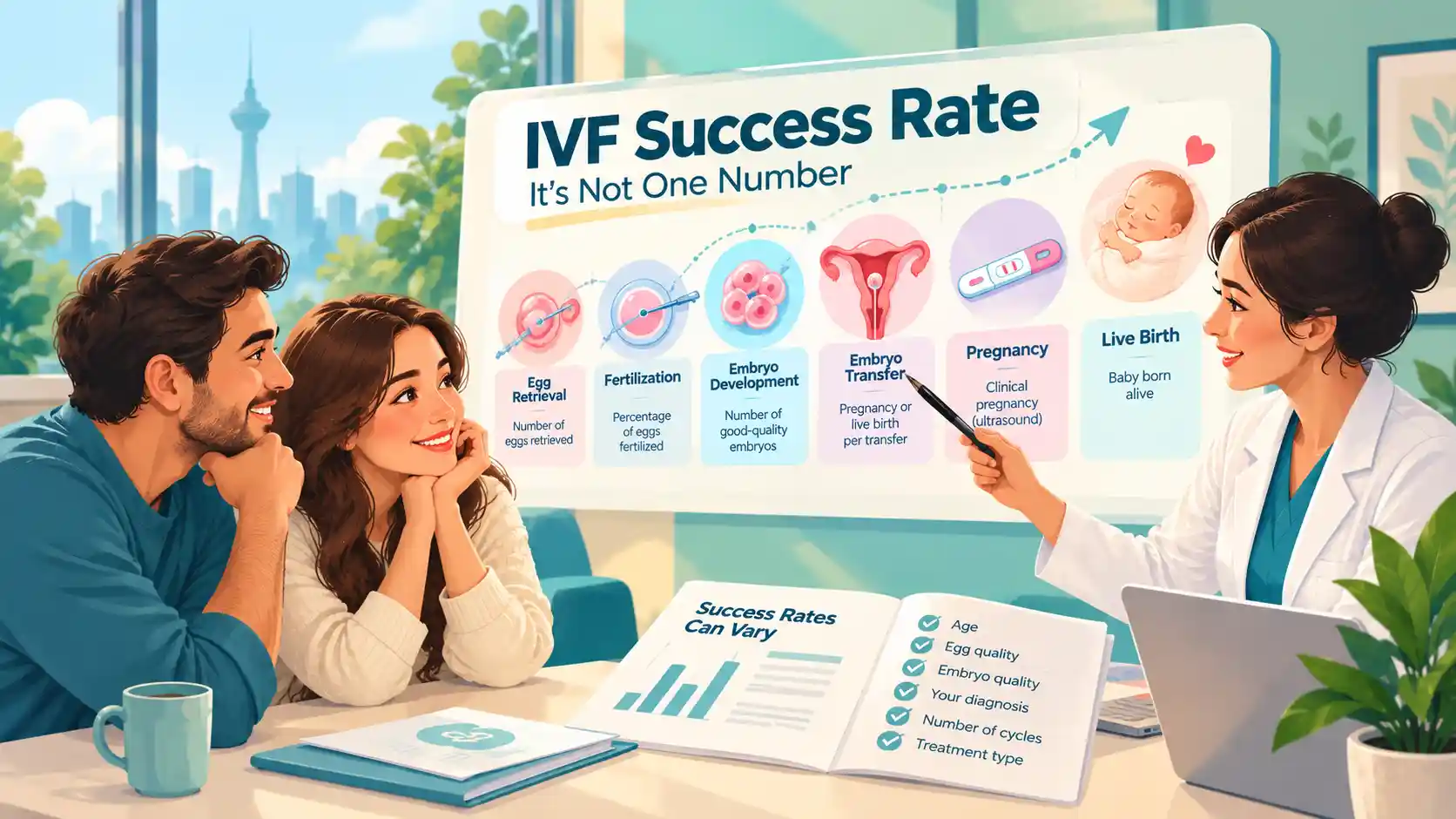
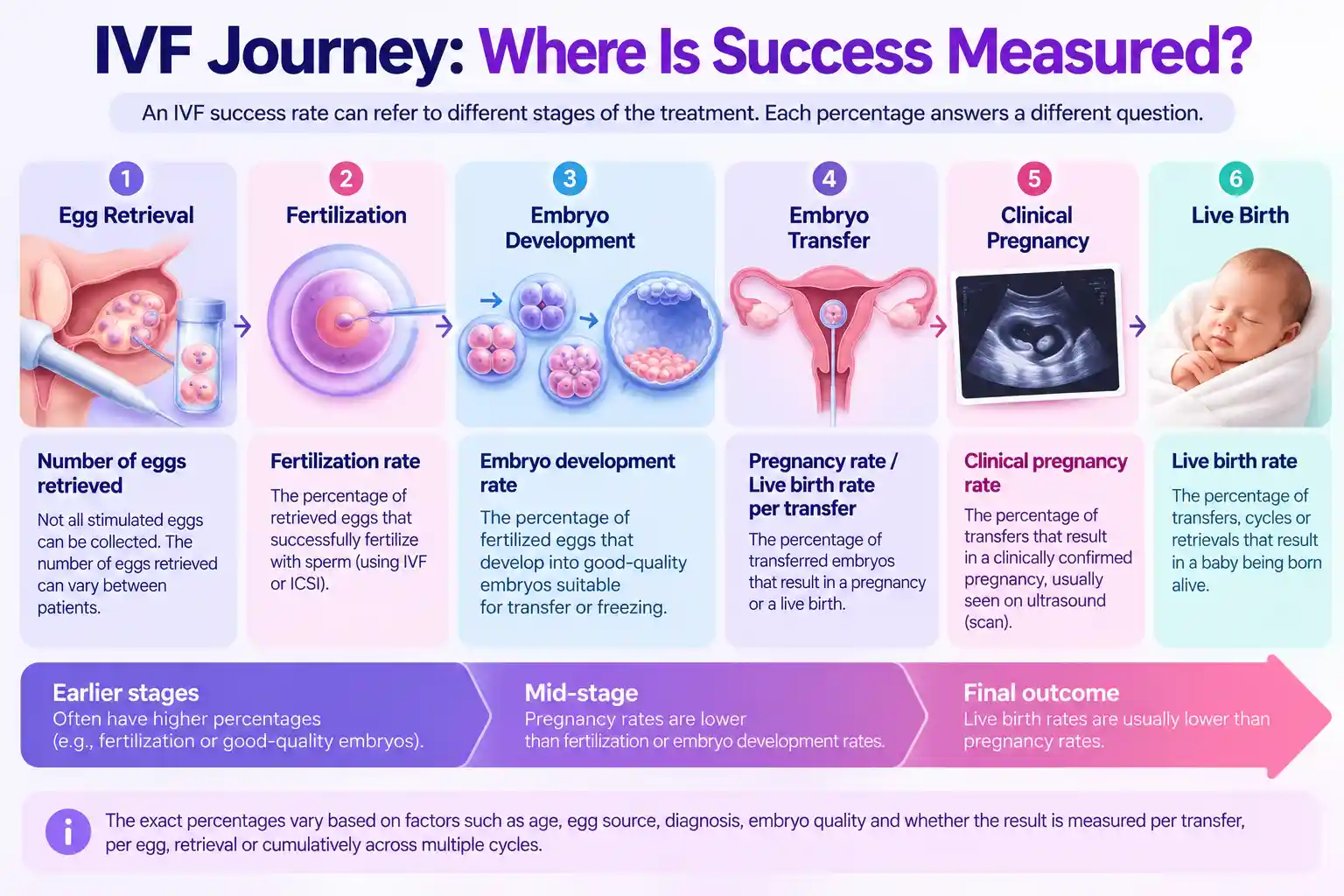
An IVF success rate can mean a positive pregnancy test, or a baby actually born. It can be counted per embryo put back, per egg retrieval, or across everything a patient goes through in a year, or even across several cycles. Change any one of those, and the same clinic, the same patients, can honestly report several different percentages at once. A number on its own, without saying which of these it is, is close to meaningless.
This article walks through what the newest national data actually show, why one IVF cycle can have more than one "correct" success rate, how many cycles it typically takes to have a baby, and which factors research actually supports — rather than repeated as marketing.
♪
Listen instead
Podcast version
Prefer to listen? Play the audio version of this page.
There Is No Single IVF Success Rate
Before comparing any numbers, it helps to pull apart two things that often get folded into one headline figure:
Pregnancy rate — a positive pregnancy test or an early clinical pregnancy.
Live-birth rate — an actual baby born.
These are not the same measurement, and the gap between them grows with age. On top of that, a result can be measured against different denominators — per embryo transferred, per egg retrieval, or added up ("cumulative") across everything that happens within about a year of one retrieval. We'll go through each of these below, because the same underlying patients can produce an 8% figure and a 55%+ figure depending only on which one is used.
Live-Birth Rate by Age: The Clearest Predictor
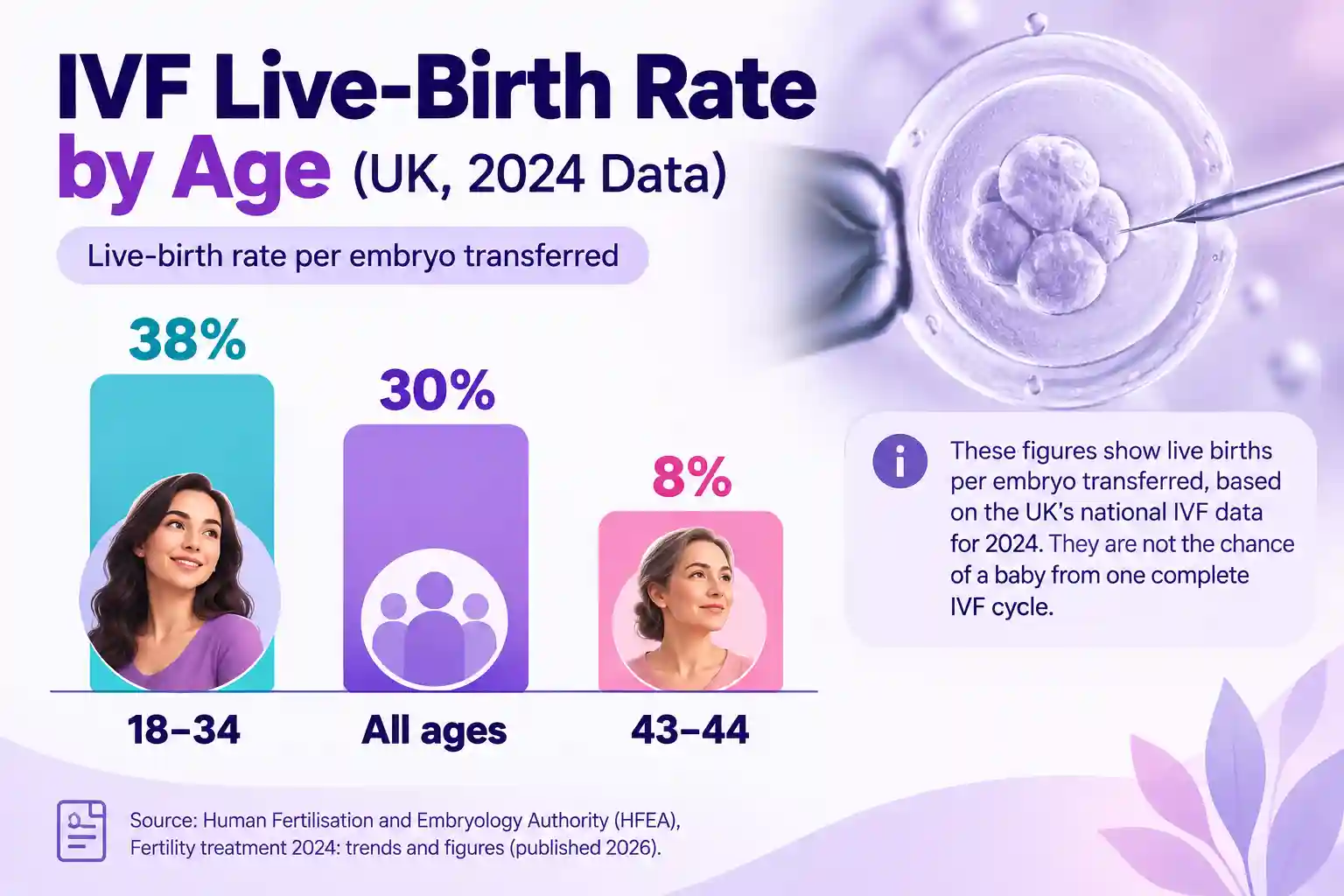
For IVF using a patient's own eggs, age is one of the strongest predictors of treatment outcome. The most recent national data from the UK's Human Fertilisation and Embryology Authority (HFEA), covering treatment given in 2024, put the average live-birth rate at 30% per embryo transferred, across all ages.
Patient age
Live-birth rate per embryo transferred, 2024
18–34
38%
All ages
30%
43–44
8%
Live-Birth Rate by Age: The Clearest Predictor
These numbers mix fresh and frozen embryo transfers, so they shouldn't be read as "the chance of a baby from one full IVF cycle" — only as the outcome once an embryo has already been put back. Frozen transfers accounted for almost 48% of all IVF cycles in the UK's 2024 data, which shows how standard freezing embryos has become in modern IVF — most patients today will go through at least one frozen transfer, not just a fresh one. The HFEA itself warns against comparing fresh and frozen outcomes directly, because the patients and embryos behind each number aren't the same group.
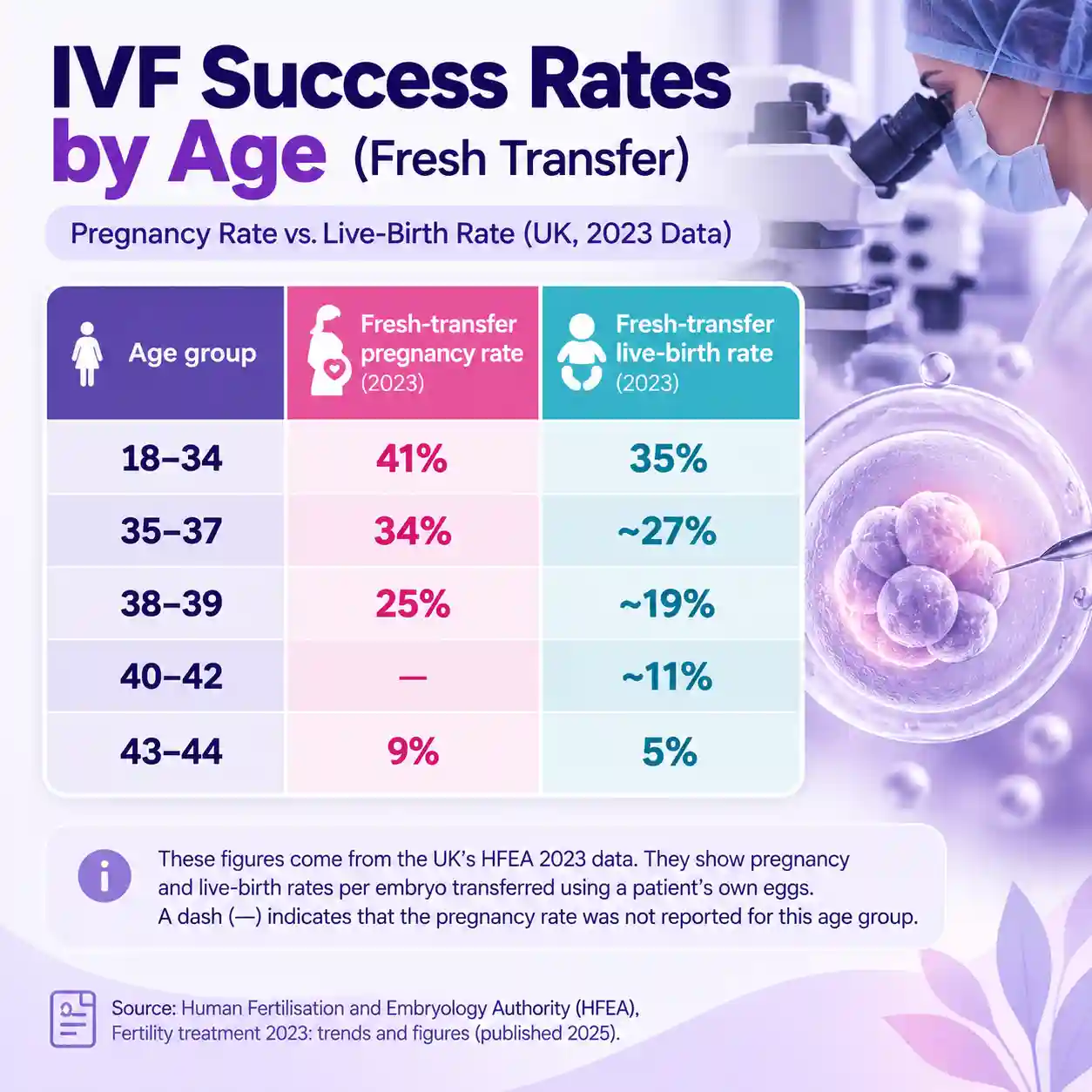
Looking only at fresh transfers using a patient's own eggs sharpens this further. In the HFEA's 2023 data, patients aged 18–34 had a 35% live-birth rate per embryo transferred, against roughly 5% for patients aged 43–44. The same data set gave pregnancy rates of 41% and 9% for those two groups — a reminder that "pregnancy rate" and "live-birth rate" are not interchangeable words for the same thing.
Age group
Fresh-transfer pregnancy rate, 2023
Fresh-transfer live-birth rate, 2023
18–34
41%
35%
35–37
34%
~27%
38–39
25%
~19%
40–42
—
~11%
43–44
9%
5%
The HFEA notes that these 2023 live-birth figures were still preliminary when released, so treat the age bands as useful context, not a personal prediction.
ivf success rate by age
What About IVF at Age 46 With Your Own Eggs?
At age 46, IVF using your own eggs generally has a very low chance of live birth because egg quality declines significantly with age. Older CDC data reported a live-birth rate of about 6% per embryo transfer for women over 42 using their own eggs, although this figure should not be treated as the exact rate for every 46-year-old.
What Is the Most Up-to-Date IVF Success Rate?
Putting the newest HFEA figures side by side: the 2024 average across all ages is 30% per embryo transferred, rising to 38% for patients aged 18–34, and falling to 8% for patients aged 43–44. These are live-birth rates per embryo transferred, not the probability that someone starting IVF today will end up with a baby from one complete treatment cycle — reaching that number first requires making it through stimulation, retrieval, fertilization, and embryo development, which is why the cumulative figures later in this article often matter more in practice.
Why the Same IVF Cycle Can Report Several "Success Rates"
Picture 100 patients starting ovarian stimulation. Not all of them reach egg retrieval. Not every egg retrieved fertilizes. Not every fertilized egg becomes an embryo good enough to transfer. This is the actual reason "live birth per embryo transferred" and "live birth per retrieval" are two different questions — not two ways of asking the same one.
The CDC reports IVF outcomes at each of these stages separately: per intended retrieval, per actual retrieval, per embryo transfer, and cumulatively across all transfers within roughly a year of one retrieval.
Measurement
What it tells you
Pregnancy per embryo transferred
How often a transferred embryo led to a reported pregnancy
Live birth per embryo transferred
How often a transferred embryo led to a live birth
Live birth per retrieval
The outcome of one egg-retrieval cycle, including any transfers that came from it
Cumulative live birth
The chance of at least one live birth across all transfers linked to one retrieval or treatment plan
A 30% live-birth rate per embryo transferred does not mean every person starting IVF has a 30% chance of taking home a baby. A patient first has to make it all the way to embryo transfer, and how many embryos are available — and how good they are — varies a great deal from one person to the next.
What "One Attempt," "One Cycle," and "Cumulative" Actually Mean
Clinics often use "attempt" and "cycle" as if they mean the same thing, and this is where a lot of confusion starts. It's worth separating three levels clearly:
One attempt — the transfer of a single embryo.
One complete cycle — one egg retrieval, plus the transfer of the fresh embryo and every frozen embryo that came from it, one at a time, until they're used up or a baby is born.
Cumulative outcome across several cycles — the chance of a baby after going through this whole IVF process two, three, or more times.
The University of Melbourne presents Australian national figures broken down exactly this way, for patients using their own eggs:
One attempt (one embryo transfer)
One complete cycle (retrieval + all resulting transfers)
Three complete cycles
Six complete cycles
Under 35
26%
51%
80%
92%
Over 35
10%
28%
52%
66%
The jump between "one attempt" and "one complete cycle" is large, because a single retrieval often produces more than one embryo, and most people don't stop trying after their very first transfer if it doesn't work.
ivf success rate after multiple cycles
IVF Success Rate After 1, 2, and 3 Cycles
This is usually the question patients care about most, and it's also the number most often left out of clinic websites: how many cycles does it typically take?
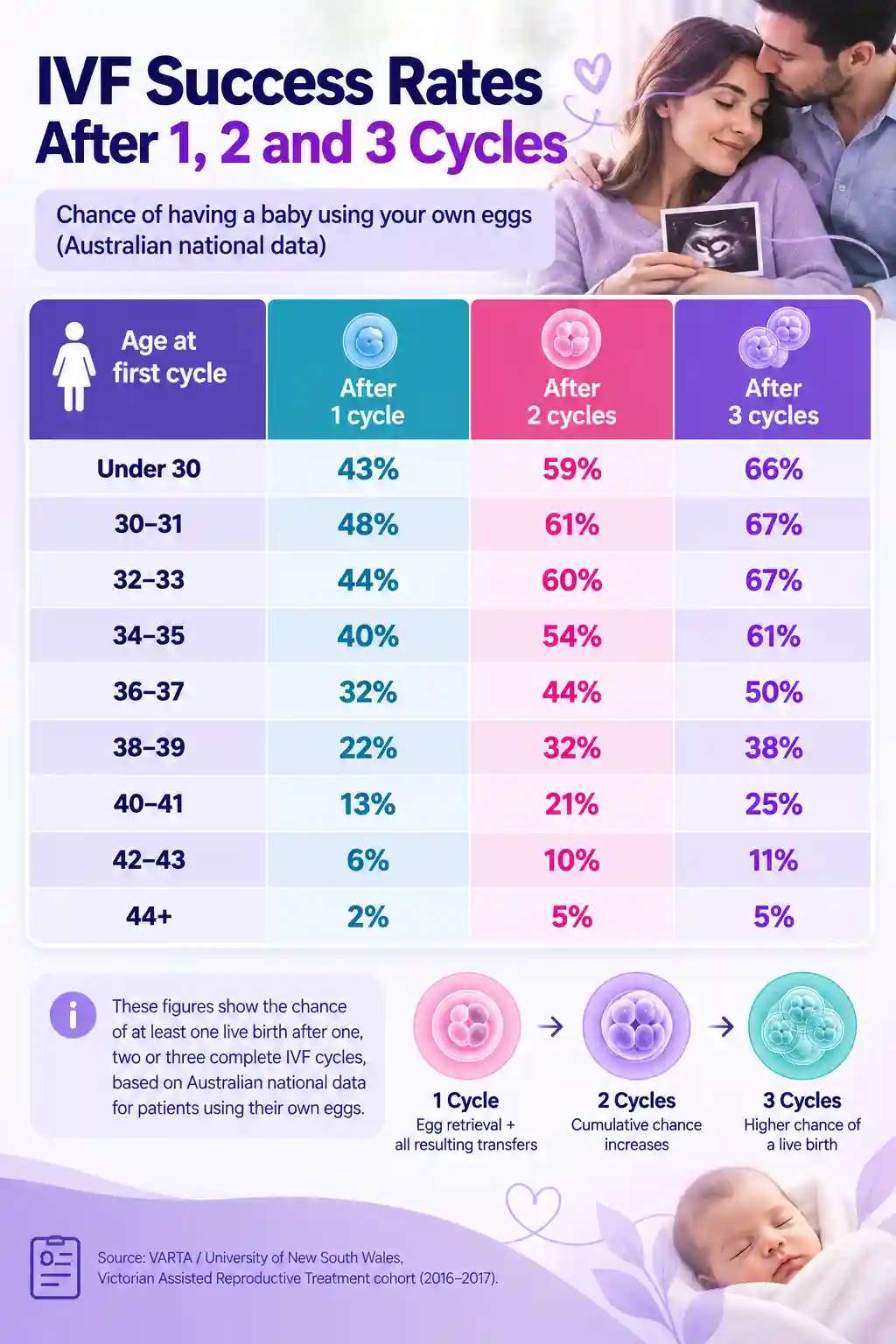
Australia's fertility regulator, VARTA, commissioned the University of New South Wales to follow thousands of women who started IVF in 2016 and 2017, and track how many of them had a baby after one, two, and three stimulated cycles (a full cycle: one egg retrieval, plus every fresh and frozen embryo transfer that came from it).
Age at first cycle
After 1 cycle
After 2 cycles
After 3 cycles
Under 30
43%
59%
66%
30–31
48%
61%
67%
32–33
44%
60%
67%
34–35
40%
54%
61%
36–37
32%
44%
50%
38–39
22%
32%
38%
40–41
13%
21%
25%
42–43
6%
10%
11%
44+
2%
5%
5%
Two things stand out in this data. First, most patients — at almost every age — do not have a baby after just one cycle, so a single failed cycle says very little on its own about the eventual outcome. Second, the gap between "after 1 cycle" and "after 3 cycles" shrinks a lot as age goes up: for a 30-year-old, a third cycle adds a meaningful 19 points; for someone over 44, three cycles barely improve on one. This is one of the clearest arguments for planning IVF as a multi-cycle strategy from the start, rather than judging it after a single attempt.
IVF Success Rate After 1, 2, and 3 Cycles
Cumulative Live Birth Is Often the More Useful Number
Because of what the table above shows, many specialists now prefer to talk about cumulative live birth rate (CLBR) — the chance of at least one baby across everything linked to one retrieval, or across a planned series of cycles — instead of a single-transfer statistic on its own.
Age still matters enormously here, but so does how many eggs a cycle produces. A 2025 prediction model built from 374 patients found that women under 35 reached close to a 99% predicted live-birth probability once 15 eggs had been retrieved; women 35–39 reached about 90% after 20 eggs; and for women 40 and over, retrieving 14 eggs corresponded to only around a 50% chance — egg number mattered most in this oldest group (Ye et al., 2025, PubMed).
Underlying diagnoses shift the cumulative number too, separately from the effect of age. A 2026 study following 1,035 women through up to three IVF/ICSI cycles found that those with ultrasound-diagnosed endometriosis and/or adenomyosis had a cumulative live-birth rate about 15% lower than women with neither condition after three cycles — although most still had a baby by the third attempt (Alson et al., 2026, PubMed).
Earlier UK data tell a similar story at a larger scale: in a cohort of nearly 180,000 women, the cumulative live-birth rate after three complete cycles rose from 30.8% for those starting treatment in 1992–1998 to 42.3% for those starting in 1999–2007, as lab techniques improved over time (Smith et al., 2015, PubMed).
What Actually Moves the Number — and What Doesn't
A 2024 review found 11 factors that show up consistently across current IVF prediction models: age, how long a patient has been trying to conceive, ethnicity, body mass index, antral follicle count, previous pregnancies, cause of infertility, sperm quality, number of eggs collected, embryo appearance under the microscope, and which day the embryo is transferred (Shingshetty et al., 2024, PubMed).
A few specific points are worth knowing because they're commonly misunderstood:
Lining thickness at transfer. A 2025 study of over 30,000 frozen embryo transfers found a very thin lining (under 7mm) was linked to a lower live-birth rate in medicated cycles — but not in fully natural ones, and lining thickness alone was a weak predictor either way (Genovese et al., 2025, PubMed).
Male partner smoking. A retrospective study of 4,004 couples found that, once age, BMI and embryo numbers were accounted for, whether the male partner smoked made no measurable difference to fresh-cycle live-birth rates (De Brucker et al., 2025, PubMed).
Environmental exposure. A 2025 meta-analysis linked higher bisphenol A (BPA) exposure to lower fertilization rates and fewer good-quality embryos, but found no clear link to clinical pregnancy or implantation on its own — an area still being studied (Yuan et al., 2025, PubMed).
How the stimulation is planned. The updated 2025 ESHRE guideline on ovarian stimulation sets out 121 recommendations, most built around tailoring the protocol to the individual patient rather than using one default approach for everyone — a reminder that how a cycle is run matters, not only who the patient is.
Where Iranian Research Fits Into This Picture
Iran has one of the longest continuous IVF track records in the region — the first Iranian IVF birth was in 1989, and by 2011 more than 50 licensed centers were together reporting roughly 35,000 IVF/ICSI cycles and 29,000 IUI cycles in a single year, according to the first national survey of Iranian fertility centers, run jointly by the Ministry of Health and the Royan Institute (Abedini et al., 2016, PMC).
What Iran doesn't yet have is a public outcome registry like the UK's HFEA or the US's CDC — one that publishes live-birth rates by age, egg source, and transfer type, for every clinic, every year. Iranian reproductive specialists have said this plainly themselves. A 2025 editorial in the Journal of Reproduction and Infertility pointed out that, worldwide, dividing the number of IVF births by the number of IVF cycles gives a real-world success rate of roughly 22% — and asked directly whether that lines up with the numbers individual clinics advertise, noting that competitive private clinics often lean on selectively reported figures (Sadeghi, 2025, JRI). That's the same caution this article has made throughout: a quoted percentage is only as good as its denominator, wherever the clinic is.
Where Iranian centers and universities have published a great deal is research into the factors behind an IVF outcome — the same kind of predictor research covered in the section above, done locally rather than imported. Iranian studies have looked at sperm DNA integrity as a predictor of fertilization results (Dehghani Ashkezari et al., SID), the timing of prolactin levels around egg retrieval (Hosseini Rashidi et al., SID), vitamin D status and pregnancy outcome in a 2022 prospective cohort (Abdolalipour et al., SID), and maternal age against egg yield and fertilization rate at Iranian IVF centers (Esmailzadeh et al., SID). Iranian groups have also studied immunological approaches for unexplained recurrent implantation failure (Saremi et al., SID) — though therapies in that category remain a debated area internationally, and most guidelines still treat them as investigational rather than routine care.
Most of these are single-center studies with a few hundred patients at most, so they sit alongside the larger national datasets covered earlier in this article, not in place of them. What they do show is a research community actively testing the same questions that international guidelines are built on — not simply applying conclusions written elsewhere.
Own Eggs vs. Donor Eggs Are Different Statistics
Donor-egg IVF should never be blended into the same percentage as IVF with a patient's own eggs. In the UK's 2024 data, 81% of IVF births came from a patient's own eggs with partner sperm, while roughly one in five IVF and donor-insemination births involved donor eggs, donor sperm, or donor embryos. Because it's the donor's age — not the recipient's — that mainly drives the outcome in donor-egg cycles, mixing the two groups into one number makes both less meaningful.
A Free Way to See Your Own Estimate
Instead of relying on one headline percentage, the CDC publishes a free IVF Success Estimator, built from national ART data. It asks for age, weight, height, prior IVF cycles, prior pregnancies, diagnosis, and egg source (own or donor), and gives back a cumulative chance-of-live-birth estimate for people aged 20 to 50, covering one, two, or three retrievals and the transfers that come from them.
How the estimator actually works. It's worth being precise about what this tool does and doesn't do: the CDC estimator does not give a clinic-specific success rate. It estimates a cumulative live-birth probability using national ART surveillance data and the outcomes of patients with similar characteristics — it is not a prediction from any single clinic's own results, and it isn't a diagnosis or a promise. The CDC itself notes its estimates are less reliable at the edges of its input ranges. It's still a useful way to see how the factors in this article combine for one specific situation, before any numbers are discussed with a clinic.
Questions to Ask Any Clinic About Its Success Rate
Before comparing two clinics, get each one to answer using the same terms:
Question
Why it matters
Is this a pregnancy rate or a live-birth rate?
Pregnancy doesn't always end in a live birth
Per embryo transferred, per retrieval, or cumulative?
Each one is a different group of patients
Fresh or frozen transfer?
These groups aren't directly comparable
Own eggs or donor eggs?
Egg source changes the outcome substantially
What age range does this cover?
Outcomes drop noticeably with age using a patient's own eggs
Single-transfer or cumulative figure?
Multiple transfers change the number a lot
How many cycles is this based on?
Small sample sizes make percentages unstable
What year is this data from?
Lab practice and patient groups shift year to year
Where Is Success Measured
The Bottom Line
The most useful thing to take from current data isn't one percentage — it's that where you measure success changes the number a great deal, and age remains strongly linked to outcomes when a patient uses her own eggs. National data put the overall live-birth rate at 30% per embryo transferred, ranging from 38% at 18–34 down to 8% at 43–44. Looked at over three full cycles instead of one transfer, a 30-year-old's chances can reach roughly two in three, while someone over 44 sees very little added benefit from extra cycles — the same underlying biology, told through two very different numbers.
At VitaLife, an individual estimate is built from age, ovarian reserve, prior IVF history, sperm factors, expected embryo numbers, egg source, and the planned treatment path — not read off a single clinic-wide percentage. If you're weighing IVF in Iran against other options, the most useful first step is a review of your own history and test results, so any success-rate conversation is grounded in your case rather than a headline number.
FAQ
What is a good IVF success rate?
There's no single universal "good" number. A 30% live-birth rate per embryo transferred is the current UK national average across all ages, but the figure that actually matters is the one that matches your age group, egg source, and transfer type.
Does frozen embryo transfer have a lower success rate than fresh transfer?
National data report fresh and frozen outcomes side by side, but the HFEA advises against comparing them directly, since only embryos judged strong enough to freeze become eligible for a later frozen transfer — which changes who's in each group to begin with.
How many IVF cycles does it typically take to have a baby?
It depends heavily on age. Data following real patients over several years shows most people need more than one stimulated cycle: for a 30-year-old, the chance rises from roughly 48% after one cycle to about 67% after three; for someone over 40, the rise across three cycles is much smaller.
Is IVF success rate the same as pregnancy rate?
No. A pregnancy rate reflects a positive test or early clinical pregnancy; a live-birth rate reflects an actual delivery. The gap between the two widens with age.
Dr. Farah Ghasemi
Gynecologist & Obstetrician · Subspecialist in Infertility & IVF
 By Dr. Farah GhasemiGynecologist & Obstetrician · Subspecialist in Infertility & IVF

No comments yet. You can start the conversation.