PGS vs PGD: What's the Difference in IVF?
PGS and PGD are often used interchangeably, but they are not the same test. PGS—now called PGT-A—screens embryos for chromosome-number abnormalities, while PGD—now split into PGT-M and PGT-SR—tests for a specific inherited gene variant or a structural chromosome rearrangement.
 By Dr. Farah GhasemiGynecologist & Obstetrician · Subspecialist in Infertility & IVF
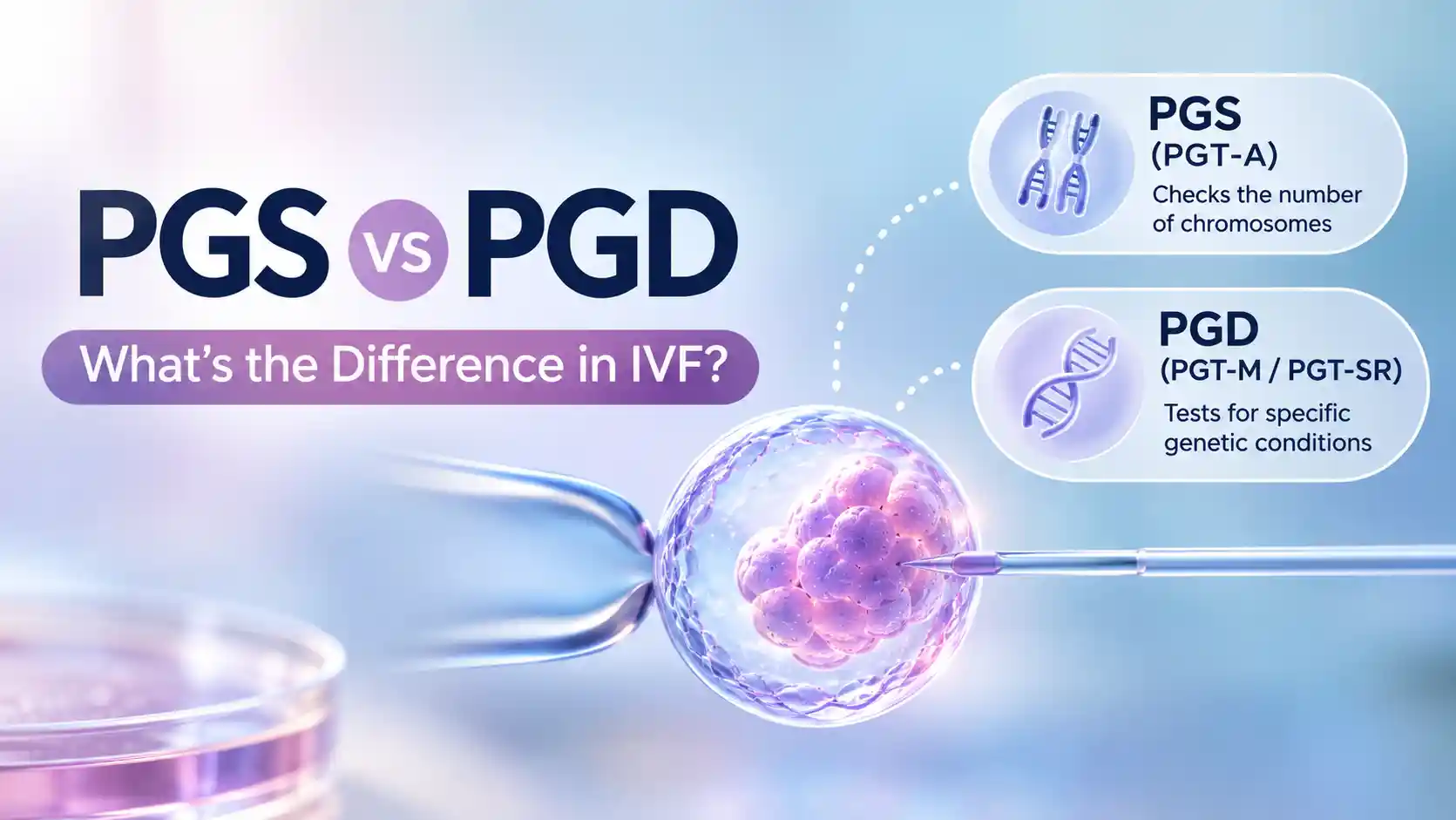
Table of contents34 sections
PGS and PGD are older terms for genetic tests performed on embryos during IVF. Although people sometimes use them interchangeably, they describe different types of testing.
PGS is the former name for PGT-A, which screens embryos for chromosome-number abnormalities. PGD is an older term generally associated with testing embryos for specific inherited genetic conditions or structural chromosome abnormalities. Today, specialists use the more precise terms PGT-A, PGT-M, and PGT-SR.
The difference matters because each test answers a different medical question. One examines chromosome numbers, another looks for a known inherited gene variant, and the third checks for particular chromosome rearrangements. Your family history, genetic test results, and fertility treatment goals determine which option, if any, you should consider.
What Is the Difference Between PGS and PGD?
The main difference is what the laboratory looks for in an embryo.
| Older term | Current terminology | What the test examines |
|---|---|---|
| PGS (Preimplantation Genetic Screening) | PGT-A | Chromosome-number abnormalities |
| PGD for single-gene disorders | PGT-M | A specific inherited gene variant |
| PGD for structural chromosome abnormalities | PGT-SR | Unbalanced chromosome rearrangements |
The medical community adopted Preimplantation Genetic Testing (PGT) as the umbrella term to describe genetic testing of eggs or embryos before transfer. PGT-A, PGT-M, and PGT-SR identify the specific type of genetic analysis.
You may still see clinics use PGS and PGD on their websites, treatment packages, or laboratory reports. When a clinic recommends either test, ask which current PGT method it actually performs and what genetic information the result will provide.
What Is PGS? Understanding PGT-A
PGS stands for Preimplantation Genetic Screening. Fertility specialists previously used this term for testing embryos for chromosome-number abnormalities.
Today, the accepted term is Preimplantation Genetic Testing for Aneuploidy (PGT-A).
Human cells usually contain 46 chromosomes arranged in 23 pairs. One set comes from the egg and the other from the sperm. An embryo with an extra or missing chromosome may have difficulty implanting, may result in a miscarriage, or may develop a chromosome-related condition.
PGT-A examines a small sample of embryo cells to look for these numerical chromosome abnormalities.
What does PGT-A detect?
PGT-A assesses whether the tested cells have the expected number of chromosomes. Depending on the laboratory platform, the analysis may identify:
- Trisomy: An extra copy of a chromosome.
- Monosomy: A missing copy of a chromosome.
- Other chromosome-number abnormalities: Including abnormalities involving sex chromosomes.
- Mosaic results: Findings suggesting that the sampled cells contain a mixture of cells with different chromosome patterns.
For example, an extra copy of chromosome 21 is associated with Down syndrome. PGT-A can identify a chromosome-number result consistent with trisomy 21 in the sampled embryo cells.
However, PGT-A is not a complete genetic health assessment. It does not test every gene or rule out every inherited or developmental condition.
Who may consider PGT-A?
A fertility specialist may discuss PGT-A with patients in situations such as:
- Advanced maternal age.
- Previous pregnancies affected by chromosome abnormalities.
- Recurrent pregnancy loss when chromosome abnormalities are a relevant concern.
- Repeated unsuccessful embryo transfers.
- Specific clinical circumstances in which information about embryo chromosome number may affect transfer planning.
However, being over 35 or having experienced a miscarriage does not automatically mean you need PGT-A.
The American Society for Reproductive Medicine (ASRM) states that research has not established the value of PGT-A as a routine screening test for every IVF patient. The Human Fertilisation and Embryology Authority (HFEA) also distinguishes between its potential to reduce miscarriage and its ability to increase the overall chance of having a baby.
Your doctor should explain the expected benefits and limitations based on your age, number of embryos, reproductive history, and treatment goals before recommending the test.
What Is PGD? Understanding PGT-M and PGT-SR
PGD stands for Preimplantation Genetic Diagnosis. Specialists traditionally used this term when they wanted to investigate a known genetic condition or an inherited chromosome abnormality before transferring an embryo.
Modern terminology separates these tests into two main categories: PGT-M and PGT-SR.
1. PGT-M: Testing for Single-Gene Disorders
PGT-M stands for Preimplantation Genetic Testing for Monogenic Disorders.
A monogenic disorder develops because of a disease-causing change in a particular gene. A parent may carry or have an inherited condition and face a risk of passing the relevant genetic variant to a child.
PGT-M allows the laboratory to examine embryos for that specific, previously identified genetic variant.
Examples of inherited conditions that may lead families to consider PGT-M include:
- Cystic fibrosis.
- Beta-thalassemia.
- Sickle cell disease.
- Spinal muscular atrophy (SMA).
- Huntington's disease.
- Certain forms of muscular dystrophy.
- Some inherited conditions linked to the X chromosome.
The laboratory does not simply screen the embryo for every possible genetic disease. It tests for the particular variant associated with the family's known genetic risk.
Who may need PGT-M?
A fertility specialist and genetic counselor may discuss PGT-M when:
- One parent has an inherited condition that could pass to a child.
- Both parents carry a disease-causing variant for the same recessive condition.
- One parent carries a known X-linked condition.
- Previous genetic testing identified a pathogenic variant in the family.
- The couple has previously had a child affected by a serious inherited condition.
For example, when both parents carry a disease-causing variant for an autosomal recessive condition such as cystic fibrosis, each pregnancy typically has a 25% chance of being affected, a 50% chance of producing an unaffected carrier, and a 25% chance of producing a child who did not inherit either variant.
PGT-M can help the laboratory identify embryos that carry or do not carry the specific condition under investigation. The appropriate result categories depend on the inheritance pattern and the family's reproductive goals.
Why does PGT-M require preparation before IVF?
PGT-M often needs more preparation than PGT-A because the laboratory must develop or validate a test for the specific genetic variant in your family.
Before treatment, the genetic team may need:
- Genetic reports identifying the disease-causing variant.
- Blood or DNA samples from one or both intended parents.
- Samples from affected relatives or other family members when they can help clarify inheritance.
- A family-specific testing strategy that can distinguish affected, unaffected, and sometimes carrier embryos.
Spanish fertility guidance from Instituto Bernabeu describes this preparatory step as an informativity study, in which the team identifies the family-specific genetic information needed to perform the embryo test.
For this reason, patients considering PGT-M should discuss genetic evaluation with the clinic before starting ovarian stimulation. Waiting until embryos already exist can create avoidable delays if the laboratory still needs to prepare the test.
2. PGT-SR: Testing for Structural Chromosome Rearrangements
PGT-SR stands for Preimplantation Genetic Testing for Structural Rearrangements.
Unlike PGT-A, which focuses on chromosome numbers, PGT-SR examines chromosome abnormalities involving their structure.
A person may carry a chromosome rearrangement without having any noticeable health condition. However, that rearrangement can increase the chance of producing eggs or sperm with an unbalanced amount of chromosome material.
Examples include:
- Translocations: A segment of one chromosome attaches to another chromosome.
- Inversions: A chromosome segment breaks and reverses its orientation.
- Other structural rearrangements: Including certain deletions, duplications, or complex chromosome changes.
A balanced translocation, for example, may not cause health problems in the parent because the person has the necessary genetic material, but the rearrangement can create embryos with missing or extra chromosome segments.
PGT-SR helps identify embryos without the unbalanced chromosome findings that the test was designed to detect. The ability to distinguish a chromosomally normal embryo from a balanced carrier embryo depends on the laboratory method.
Who may consider PGT-SR?
A specialist may recommend discussing PGT-SR when:
- One parent has a balanced translocation.
- A parental chromosome analysis identifies an inversion or another structural rearrangement.
- The couple has experienced recurrent pregnancy losses associated with a known chromosome rearrangement.
- Previous pregnancy or genetic testing identified an unbalanced chromosome result related to a parental rearrangement.
Before treatment, the fertility specialist and genetic laboratory should review the parents' chromosome reports and confirm that the selected testing method can identify the relevant unbalanced chromosome outcomes.
PGS vs PGD vs PGT-A, PGT-M, and PGT-SR: Side-by-Side Comparison
The following comparison brings the main differences together:
| Feature | PGT-A (Former PGS) | PGT-M (Former PGD) | PGT-SR (Former PGD) |
|---|---|---|---|
| Main target | Chromosome number | Specific gene variant | Chromosome structure |
| Looks for | Extra or missing chromosomes | Known inherited single-gene condition | Unbalanced chromosome rearrangements |
| Typical reason for testing | Evaluate embryo aneuploidy | Reduce the risk of passing on a known genetic condition | Address a parental chromosome rearrangement |
| Requires a known family mutation? | No | Yes | Requires identification of the relevant parental rearrangement |
| Requires parental chromosome testing? | Not usually | Genetic testing of the relevant variant | Usually requires parental karyotype or other appropriate chromosome analysis |
| Can identify every genetic disease? | No | No | No |
The most important distinction: PGT-A examines chromosome numbers, PGT-M examines a specific inherited gene variant, and PGT-SR examines structural chromosome abnormalities. They are not interchangeable tests.
How Are PGS and PGD Tests Performed During IVF?
All three modern PGT methods usually take place as part of an IVF or ICSI treatment cycle. The laboratory performs the genetic analysis on cells collected from embryos before transfer.
The process generally follows these steps:
1. Ovarian Stimulation and Egg Retrieval
The patient takes prescribed fertility medications to stimulate the ovaries and develop multiple follicles. The clinic monitors the response and retrieves mature eggs when they are ready.
2. Fertilization and Embryo Development
The embryology team fertilizes the retrieved eggs with sperm using conventional IVF or ICSI, depending on the medical plan.
The laboratory then monitors embryo development. Suitable embryos may continue growing to the blastocyst stage, usually around day 5, 6, or 7 after fertilization.
3. Embryo Biopsy
The embryologist collects a small sample of cells from the embryo for genetic analysis. In many current PGT programs, the laboratory takes the sample from the trophectoderm, the outer cell layer of the blastocyst.
The trophectoderm contributes to placental development, while the inner cell mass develops into the fetus.
The laboratory sends the sample for the requested analysis: PGT-A, PGT-M, PGT-SR, or a combination when clinically appropriate.
4. Embryo Freezing and Genetic Analysis
Many clinics freeze suitable embryos after biopsy while the genetics laboratory analyzes the samples.
For PGT-M, the laboratory must have the family-specific testing method ready. PGT-A and PGT-SR also depend on the laboratory platform and the chromosome findings being investigated.
The testing time varies by method, laboratory, and whether the clinic needs additional genetic preparation.
5. Review of Results and Embryo Transfer
The laboratory issues a report for each embryo it successfully tests. The fertility team reviews the findings, explains which embryos may be suitable for transfer, and discusses the next treatment step.
A suitable embryo may undergo a frozen embryo transfer once the clinic confirms that the patient or gestational carrier is ready.
Not every embryo will reach the blastocyst stage, qualify for biopsy, or produce an interpretable result. Genetic testing therefore cannot guarantee that a cycle will produce an embryo suitable for transfer.
What Do PGT Results Mean?
Understanding the laboratory report is an important part of the process. A result labelled normal, abnormal, or mosaic does not always tell the whole story.
PGT-A results
Laboratories commonly report one of the following:
- Euploid: The tested cells show the expected chromosome number.
- Aneuploid: The tested cells show an extra or missing chromosome.
- Mosaic: The sample shows findings consistent with a mixture of cells with different chromosome patterns.
- No result or inconclusive: The laboratory could not provide a reliable classification from the sample.
A euploid result does not guarantee successful implantation or a healthy baby. It only means that the tested sample showed the expected chromosome number within the limits of the test.
PGT-M results
Depending on the disease and inheritance pattern, the report may classify an embryo as affected, unaffected, or a carrier of the specific genetic variant.
The clinic should explain what each result means for the child and whether an embryo carrying the variant can still be considered for transfer under the family's medical plan.
PGT-SR results
The report identifies chromosome findings in relation to the structural rearrangement under investigation.
Depending on the technology, the laboratory may distinguish embryos with an unbalanced rearrangement from embryos with normal or balanced chromosome findings. Ask whether the testing method can distinguish a normal embryo from an embryo that carries the parent's balanced rearrangement.
Can PGT Results Be Inaccurate?
Yes. PGT provides valuable genetic information, but it cannot examine every cell in an embryo or detect every possible genetic condition.
One important limitation is embryonic mosaicism.
A mosaic embryo contains cells with different chromosome patterns. Because a biopsy samples only a small number of cells from the trophectoderm, the results may not represent every cell in the embryo.
The classification of a mosaic result can also vary between laboratories. Testing platforms, reporting thresholds, sample handling, and laboratory interpretation can influence how the report categorizes an embryo.
ASRM recognizes that some embryos reported as mosaic can implant and result in apparently chromosomally normal live births. However, their chances of implantation may be lower, depending on the specific findings.
A mosaic result does not automatically mean that the embryo cannot be transferred. The fertility specialist and genetic counselor should review the chromosome involved, the type and level of mosaicism, available alternatives, and any relevant clinical guidance.
Other limitations include:
- A sample may produce no interpretable result.
- The biopsy may not represent all embryo cells.
- Technical errors can produce false-positive or false-negative findings.
- PGT-M may not detect genetic conditions outside the specific variant tested.
- PGT-A does not rule out all single-gene disorders or structural abnormalities.
- PGT-SR can only identify rearrangements that the selected method can detect.
For these reasons, a PGT result does not replace prenatal genetic screening or diagnostic testing during pregnancy. ACOG recommends offering appropriate prenatal testing options after PGT, including diagnostic testing when indicated.
Does PGS or PGD Increase IVF Success Rates?
PGT can help fertility specialists make more informed embryo-transfer decisions, but the tests do not guarantee a pregnancy or live birth.
The evidence differs by test type.
PGT-A: Selecting an embryo with an expected chromosome number may improve implantation outcomes per transfer in some patient groups and may reduce miscarriages related to chromosome abnormalities. However, ASRM has not established that routine PGT-A improves overall live-birth rates for every patient undergoing IVF.
The HFEA also rates PGT-A differently depending on the outcome: it does not support the claim that PGT-A increases the chance of having a baby for most fertility patients, while recognizing evidence that it can reduce miscarriage in certain circumstances.
PGT-M: The main purpose is to reduce the risk of transferring an embryo affected by the specific inherited condition under investigation. It does not guarantee implantation or a live birth.
PGT-SR: The test helps identify embryos without the unbalanced chromosome findings associated with the parental rearrangement. It does not eliminate every reproductive risk or guarantee a successful pregnancy.
When a clinic discusses success rates, ask whether its figures describe implantation, clinical pregnancy, miscarriage, or live birth. Also ask whether the results apply to PGT-A, PGT-M, or PGT-SR rather than combining different testing methods into one percentage.
Is PGS or PGD Used for Gender Selection?
Embryo genetic testing can also provide information about sex chromosomes. For example, PGT-A may identify whether the tested embryo sample has an XX or XY chromosome pattern.
However, identifying sex chromosomes is not the same as testing for an inherited disease.
PGT-M may be relevant when a family has a known sex-linked genetic condition. In that situation, the laboratory tests for the disease-causing variant and helps the team identify embryos that do not have the condition.
Nonmedical sex selection, sometimes described as family balancing, raises separate ethical and legal questions. Laws and clinic policies differ between countries.
In Iran, Article 3 of the government program on assisted reproduction, notified under Cabinet Resolution No. 86939 on 26 Mehr 1405, states that assisted-reproduction methods for selecting inherited traits or embryo sex are permitted only for therapeutic purposes. Patients considering treatment in Iran must therefore confirm the medical indication and eligibility with an appropriately licensed fertility centre and qualified legal adviser.
The technical relationship between embryo testing and sex selection is explained in our guide to gender selection in Iran, but access to nonmedical family balancing should not be assumed.
What Should You Ask Before Paying for PGS or PGD?
Before agreeing to embryo testing, ask your fertility specialist and genetics laboratory specific questions about the test and its limitations.
Which test do you recommend: PGT-A, PGT-M, or PGT-SR?
What medical finding makes this test relevant to my situation?
Which chromosomes or genetic variants will the laboratory examine?
Does my family need additional genetic testing before IVF?
Does PGT-M require a custom test to be developed before treatment?
At what embryo stage will the laboratory perform the biopsy?
What results can the laboratory report, including mosaic or inconclusive findings?
How does the clinic handle embryos reported as mosaic?
What happens if the laboratory cannot interpret a sample?
Should I still consider prenatal genetic testing after pregnancy?
Also request an itemized estimate. Confirm whether the quoted price includes embryo biopsy, genetic analysis, testing each embryo, freezing, storage, and any additional testing or transfer fees.
Planning PGS or PGD With VitaLife
At VitaLife, we help international patients coordinate fertility treatment in Iran through our partner clinics.
If your doctor has recommended PGS or PGD, our team can help organize your previous IVF reports, genetic test results, family medical history, and treatment goals before coordinating a consultation with the partner clinic.
The treating fertility specialist and genetics team determine which test is appropriate, whether the laboratory needs additional family testing, and which embryos may be suitable for transfer.
For PGT-M, sharing previous genetic reports before starting IVF is particularly important because the laboratory may need to prepare a family-specific testing method.
We can also help international patients understand the expected treatment stages, coordinate clinic appointments, and plan the practical arrangements for treatment in Iran.
Contact the VitaLife team to discuss your IVF and embryo genetic testing options before arranging your visit.
Frequently Asked Questions About PGS and PGD
Is PGS the same as PGT-A?
Yes. PGS is the older name for PGT-A, which screens embryo cells for chromosome-number abnormalities.
Is PGD the same as PGT-M?
Not exactly. PGD is an older term that was used for preimplantation testing of known inherited genetic conditions and structural chromosome abnormalities. PGT-M is the current term for testing specific monogenic disorders. PGT-SR covers structural chromosome rearrangements.
Which is better, PGS or PGD?
Neither test is universally better. They examine different genetic findings. PGT-A evaluates chromosome numbers, PGT-M tests a known gene variant, and PGT-SR checks structural chromosome rearrangements. Your medical history determines which test, if any, is appropriate.
Is PGT-A recommended for every woman over 35?
No. Age can affect the likelihood of embryo aneuploidy, but being over 35 does not automatically mean you need PGT-A. Your fertility specialist should discuss the potential benefits and limitations based on your age, embryo numbers, treatment history, and personal goals.
Can PGT detect Down syndrome?
PGT-A may identify a chromosome-number result consistent with trisomy 21, which causes Down syndrome, in the tested embryo cells. However, PGT cannot guarantee that a future child will have no chromosome or genetic condition. Prenatal screening and diagnostic testing remain important options during pregnancy.
Can PGT detect thalassemia?
PGT-M may detect a known disease-causing variant associated with thalassemia when the family has completed the necessary genetic testing and the laboratory has prepared an appropriate testing method.
Does PGT guarantee a healthy baby?
No. PGT examines specific genetic or chromosome findings in a small embryo-cell sample. It cannot rule out every genetic condition, developmental difference, or pregnancy complication. A normal result also does not guarantee implantation or live birth.
What happens if PGT-A reports a mosaic embryo?
The result suggests that the sampled cells show a mixture of chromosome patterns. The clinic should review the specific chromosome finding and the laboratory's reporting criteria with a genetic counselor. Some mosaic embryos may be considered for transfer in selected circumstances, but the risks and expected outcomes vary.
Can a clinic perform PGT-A and PGT-M together?
Yes. A laboratory may perform both tests when the couple needs chromosome-number screening and testing for a known inherited single-gene condition. The medical team should explain whether combined testing will change the available embryo results or treatment plan.
Is embryo genetic testing performed before or after embryo transfer?
The laboratory performs PGT before embryo transfer. It collects a small sample from the embryo, analyzes the genetic material, and reports the findings so the fertility team can plan
Comments 0
Share a question or experience related to this article. Comments appear after review by our team.
No comments yet. You can start the conversation.