Embryo Grading in IVF
Embryo grading in IVF describes an embryo’s development and appearance under a microscope. In grades such as 5AA, 4BB, and 3BB, the number indicates blastocyst expansion, while the two letters describe the inner cell mass and trophectoderm. Higher grades generally indicate more favorable morphology, but lower-grade embryos can still result in healthy pregnancies.
 By Dr. Farah GhasemiGynecologist & Obstetrician · Subspecialist in Infertility & IVF
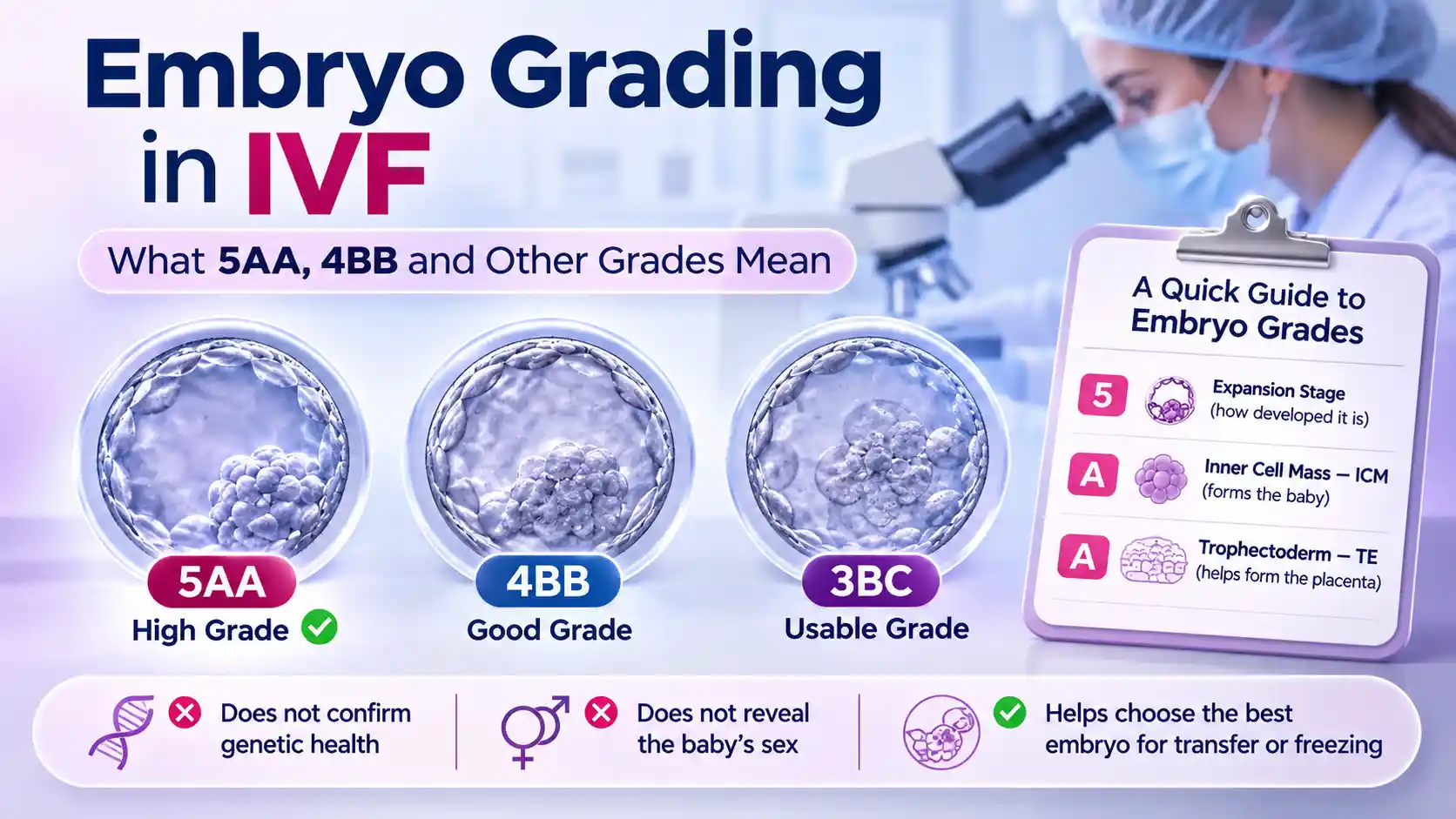
Table of contents36 sections
When you receive your IVF embryo report, you may see grades such as 5AA, 4BB, 3BB, or 5BC. These numbers and letters describe how an embryo looks and how far it has developed in the laboratory. But what do they actually mean? Is a 5AA embryo better than a 4BB? Can a 3BB embryo still become a healthy baby? And can an embryo grade tell you whether you have a boy or a girl?
Embryo grading is a visual assessment that helps embryologists evaluate and rank embryos for transfer or freezing. A higher morphological grade generally indicates more favorable features, but it cannot confirm that an embryo has normal chromosomes or guarantee pregnancy.
This guide explains how to read your embryo report, understand the meaning of each number and letter, and know which questions to ask your fertility clinic.
How to Read Your IVF Embryo Grade
If your report shows a grade such as 4BB, you can read it in three parts:
- 4: The blastocyst expansion stage.
- First B: The appearance of the inner cell mass (ICM).
- Second B: The appearance of the trophectoderm (TE).
The Gardner grading system is widely used to assess blastocysts, which are embryos that have usually developed for five or six days after fertilization.
For example, a 4BB embryo is an expanded blastocyst with B-grade inner cell mass and B-grade trophectoderm. This tells you about its appearance at the time of assessment, not its exact probability of becoming a baby.
It also helps to understand three terms that embryologists use:
- Grading: Examining an embryo and assigning a score based on its appearance and development.
- Ranking: Arranging embryos considered suitable for clinical use from the most favorable to the less favorable.
- Selection: Deciding which embryo to transfer after considering its grade, developmental day, genetic information when available, and the patient's medical circumstances.
These are not the same thing. An embryo with the highest-looking grade is not automatically the only factor in the transfer decision.
Routine morphological grading is a visual assessment under a microscope. It does not involve removing cells from the embryo. A biopsy for genetic testing, such as PGT-A, is a separate procedure.
How Does an Embryo Develop During IVF?
Embryo grading changes as the fertilized egg develops. The main stages are:
| Development day | Embryo stage | What happens |
|---|---|---|
| Day 0 | Fertilization | The egg and sperm combine to form a zygote |
| Day 1 | Zygote | Fertilization is assessed, including the presence of two pronuclei |
| Day 2 | Cleavage stage | The embryo commonly reaches around 4 cells |
| Day 3 | Cleavage stage | An embryo commonly reaches around 8 cells |
| Day 4 | Morula | Cells compact into a dense group |
| Day 5–6 | Blastocyst | A fluid-filled cavity and two distinct cell populations develop |
| Day 7 | Late blastocyst | Some embryos reach the blastocyst stage later |
These are expected developmental milestones, not rigid deadlines. Embryos do not all develop at exactly the same speed.
If your day-one report says 2PN, this usually means that the embryologist observed two pronuclei after fertilization. It is a fertilization assessment, not an embryo quality grade.
Day 2 and Day 3 Embryo Grading
Before an embryo becomes a blastocyst, embryologists assess its cleavage-stage development. They look at the number of cells, their size and symmetry, fragmentation, and whether abnormal nuclei are visible.
The updated 2025 ESHRE/Alpha Istanbul Consensus identifies approximately four cells on day 2 and eight cells on day 3 as important developmental reference points.
Embryologists also consider:
- Cell number: Whether the embryo has divided at an expected rate.
- Cell symmetry: Whether the cells are similar in size, taking the developmental stage into account.
- Fragmentation: How much small cellular material has separated from the embryo.
- Nucleation: Whether cells show an expected nuclear pattern.
The 2025 consensus identifies less than 10% fragmentation as a favorable feature during cleavage-stage assessment. More fragmentation may be associated with reduced developmental potential, but it does not automatically mean an embryo cannot continue developing.
How to Understand a Day 3 Embryo Report
A report may use descriptions such as:
- 8-cell: An embryo with eight cells. This describes the number of cells, not its quality grade.
- 8C-4: In some laboratories, this may indicate an eight-cell embryo with a separate morphology grade of 4.
- Grade 1, 2, 3 or 4: A laboratory-specific assessment of cell appearance and fragmentation.
Be careful when comparing grades between clinics. At Bourn Hall, for example, grade 4 represents more evenly sized cells, while grade 1 represents more uneven cells. Other laboratories use the opposite direction, with grade 1 as the best. The scale must be interpreted using the laboratory's own definitions.
You may also see terms such as Excellent, Good, Fair, or Poor rather than a number or letter. Some grading systems use these as overall descriptive categories alongside the embryo's developmental stage. They do not have a universal one-to-one conversion into Gardner grades. For example, a Fair result does not automatically mean a 4BB embryo.
A grade 3 embryo is not automatically poor quality. Uneven-looking cells can sometimes reflect asynchronous cell division rather than an embryo with no developmental potential.
Another important point is that not every embryo reaches the blastocyst stage. Some clinics continue culturing embryos until day 5, 6 or 7 to gain more information before choosing an embryo. This can help identify embryos that have continued developing, but it also creates a possibility that none will reach a stage suitable for transfer or freezing.
For patients with only a few embryos, the choice between day 3 transfer and extended culture needs individual consideration. Neither approach is automatically best for everyone. The decision should take into account embryo numbers, development so far, previous treatment, and the experience of the IVF laboratory.
Day 4: What Is a Morula?
Around day 4, the embryo typically enters the morula stage. Its cells become tightly connected in a process called compaction, making individual cell boundaries less visible.
Embryologists assess whether compaction is progressing appropriately and whether the embryo is beginning to form a fluid-filled cavity.
The 2025 Istanbul Consensus recognizes full compaction and early cavitation as useful features when ranking day 4 embryos. However, morula grading is less standardized than blastocyst grading, and the clinical significance of some day 4 features remains uncertain.
Day 5 and Day 6: Understanding Blastocyst Grading
By day 5 or 6, some embryos develop into blastocysts. A blastocyst contains three important structures:
- Inner cell mass (ICM): A group of cells that develops into the fetus.
- Trophectoderm (TE): The outer cell layer that contributes to the placenta and plays an important role in implantation.
- Blastocoel: The fluid-filled cavity inside the blastocyst.
At this stage, embryologists commonly use the Gardner grading system to describe the embryo's development and appearance.
Gardner Embryo Grading Chart: What Do the Numbers and Letters Mean?
A Gardner grade contains one number followed by two letters, such as 5AA or 4BB.
- The number describes the blastocyst's expansion and hatching stage.
- The first letter describes the inner cell mass.
- The second letter describes the trophectoderm.
1. Blastocyst Expansion Grades: 1–6
| Grade | Meaning | Description |
|---|---|---|
| 1 | Early blastocyst | The fluid cavity occupies less than half of the embryo |
| 2 | Blastocyst | The cavity occupies at least half of the embryo |
| 3 | Full blastocyst | The cavity fills the embryo |
| 4 | Expanded blastocyst | The cavity has expanded and the outer shell has become thinner |
| 5 | Hatching blastocyst | The embryo is beginning to emerge through its outer shell |
| 6 | Hatched blastocyst | The embryo has completely emerged from the shell |
A higher expansion number does not automatically mean an embryo is genetically healthier or more likely to result in a live birth. It describes a developmental stage, not an overall quality score.
For example, a grade 6 blastocyst has completed hatching, while a grade 5 blastocyst is still emerging from its shell. The embryologist considers this information together with the two letter grades.
2. Inner Cell Mass (ICM) Grades: A–D
| Grade | Description |
|---|---|
| A | Many tightly packed cells forming a clearly defined group |
| B | Several cells that are more loosely grouped |
| C | Very few visible cells |
| D | No distinct inner cell mass or degenerating cells |
The ICM is important because it develops into the fetus. Its appearance is one of the features used to rank blastocysts.
3. Trophectoderm (TE) Grades: A–D
| Grade | Description |
|---|---|
| A | Many cells forming a cohesive, organized outer layer |
| B | A moderate number of cells forming a relatively loose layer |
| C | Few, larger cells with less organized layer formation |
| D | Sparse or degenerating cells |
The trophectoderm contributes to placental development and is important for implantation.
The updated 2025 ESHRE/Alpha Istanbul Consensus distinguishes a C-grade embryo from a D-grade embryo. C means that fewer or less organized cells are visible; D is used when cells are absent or show degenerative features. Not every laboratory uses D in its routine grading report, so the clinic's own grading method matters.
Is My Embryo Grade Good? Examples Explained
Here are some of the most common grades patients see on IVF reports.
| Embryo grade | Meaning | General interpretation |
|---|---|---|
| 5AA | Hatching blastocyst, A-grade ICM and A-grade TE | Very favorable morphology |
| 4AA | Expanded blastocyst, A-grade ICM and A-grade TE | Very favorable morphology |
| 4AB | Expanded blastocyst, A-grade ICM and B-grade TE | Favorable morphology |
| 4BA | Expanded blastocyst, B-grade ICM and A-grade TE | Favorable morphology |
| 4BB | Expanded blastocyst, B-grade ICM and B-grade TE | Often considered a usable, moderate-to-good grade |
| 3BB | Full blastocyst, B-grade ICM and B-grade TE | A potentially usable blastocyst |
| 5BC | Hatching blastocyst, B-grade ICM and C-grade TE | Lower morphological grade, but may still be viable |
| 3CC | Full blastocyst, C-grade ICM and C-grade TE | Lower morphological grade; clinic-specific assessment is important |
A 2025 systematic review and meta-analysis of 33 studies involving 42,974 embryos found that several blastocyst morphology features were associated with live-birth outcomes. This supports the general value of embryo grading, but it does not create a reliable personal success percentage for each grade.
Is a 5AA Embryo the Best?
A 5AA embryo has several favorable features. It has reached the hatching stage, and both its inner and outer cell groups have an A-grade appearance.
This usually makes it a high-priority embryo for consideration. However, a 5AA grade does not prove that the embryo is chromosomally normal or guarantee that implantation will occur.
Is a 4BB Embryo Good Enough for Pregnancy?
Yes, a 4BB embryo can result in pregnancy and live birth. It is an expanded blastocyst with B-grade features in both cell groups.
Many fertility laboratories consider embryos with this grade suitable for transfer or freezing, depending on their own criteria, the embryo's developmental day, and the patient's treatment history.
What Is the Difference Between 4AB and 4BA?
Both are grade 4 expanded blastocysts, but their letter grades are reversed:
- 4AB: A-grade inner cell mass and B-grade trophectoderm.
- 4BA: B-grade inner cell mass and A-grade trophectoderm.
There is no universal rule that one must always be transferred before the other. Researchers have reached different conclusions about whether ICM or TE is the stronger predictor of live birth. A 2024 study of frozen blastocyst transfers found a stronger association with TE quality, while a 2026 study of 2,694 single frozen blastocyst transfers found ICM to be the stronger predictor in its analysis.
The 2025 international consensus also notes that assigning a fixed relative importance to each feature is complicated by differences between fresh and frozen transfers and between tested and untested embryos.
In practical terms, your embryologist should compare the complete embryo report, including developmental day and expansion, rather than choosing between AB and BA based on one letter alone.
Is 4AA Better Than 5AA?
Both are favorable morphological grades. A 4AA is an expanded blastocyst, while a 5AA has started to hatch from its outer shell.
The number describes the developmental stage, not a simple score of overall quality. A 5AA may be ranked ahead of a 4AA in some circumstances, but the embryo's developmental day, timing of assessment, and the laboratory's criteria also matter.
Hatching is a normal part of blastocyst development. It allows the embryo to emerge from the zona pellucida before implantation. Seeing a hatching embryo is not a problem by itself, but a grade 5 does not guarantee a better outcome than every grade 4 embryo.
Should You Give Up on a 3BB or 5BC Embryo?
No. A lower morphological grade does not automatically mean an embryo is unsuitable.
The 2025 ESHRE/Alpha Istanbul Consensus recognizes that blastocysts with C-grade ICM or TE can still be viable and may be considered for clinical use. The decision depends on the complete assessment and the laboratory's policy.
A C grade should also not be confused with a D grade: the updated consensus uses D for embryos with degenerating features or no distinct ICM.
Does Day 5, Day 6 or Day 7 Make a Difference?
Yes. The day an embryo becomes a blastocyst is another important part of its report.
Some embryos develop quickly and reach the blastocyst stage on day 5. Others need until day 6 or day 7.
In general, faster-developing blastocysts tend to have more favorable outcomes, and day 5 embryos often rank ahead of otherwise similar day 6 embryos. However, the difference is not an absolute rule.
A day 6 embryo can still be an excellent embryo. Even day 7 blastocysts may be viable and can be considered for clinical use, particularly when only a few embryos are available.
For example, a 4AA embryo that develops on day 5 and a 4AA embryo that develops on day 6 have the same visible Gardner grade, but their developmental timing is different. Your embryologist may consider both details when deciding which embryo to use first.
This is one reason why a day 6 4BB embryo should not be dismissed simply because another embryo developed on day 5. The full report and any genetic results matter.
Does a Better Embryo Grade Mean a Higher Chance of Pregnancy?
Generally, embryos with more favorable morphology have higher implantation and live-birth potential. But the grade alone cannot tell you your exact chance of pregnancy.
A 2025 systematic review and meta-analysis found that several features of blastocyst morphology were associated with live-birth outcomes. However, the relative importance of expansion, ICM, and TE can vary, and the study does not establish one universal ranking that applies to every patient or laboratory.
Two embryos with the same Gardner grade may have different developmental potential. Likewise, an embryo with a lower morphological grade may still implant and result in a healthy birth.
Other important factors include:
- Age of the egg provider: The age when the eggs were retrieved is important when assessing the likelihood of chromosome abnormalities. You cannot determine the egg provider's age or reproductive history by looking at the embryo.
- Chromosomal status: An embryo that looks excellent may still have an abnormal number of chromosomes.
- Day of development: Reaching the blastocyst stage on day 5, 6 or 7 can influence embryo ranking.
- Uterine conditions: The endometrium and timing of transfer also matter.
- Laboratory conditions: Culture procedures and the experience of the embryology team influence assessment and outcomes.
- Previous embryo development: When several embryos come from the same cycle, their development may provide useful information for the treating team, although one embryo's result does not determine the outcome of another.
For patients using donated eggs or a gestational carrier, it is especially important to understand that embryo morphology, egg-provider age, and the uterine environment provide different pieces of information.
There is no reliable universal pregnancy percentage for every 5AA, 4BB or 3BB embryo. Be cautious with online charts that promise a fixed success rate for each grade. Ask your clinic for outcome estimates that reflect your age group, embryo type, developmental day, genetic results, and treatment circumstances.
Can a Day 6 or Day 7 Embryo Still Result in Pregnancy?
Yes. Not all embryos reach the blastocyst stage at the same speed.
Some become blastocysts on day 5, while others need until day 6 or day 7. Research generally associates slower blastocyst development with lower implantation and live-birth potential compared with faster development, but later-developing embryos can still produce healthy pregnancies.
The 2025 Istanbul Consensus specifically recognizes that day 7 blastocysts can be viable and may be considered for clinical use. This can be particularly relevant for patients who have only a small number of embryos available.
When comparing two embryos, embryologists may therefore consider both their Gardner grades and the day on which they reached the blastocyst stage.
Does Time-Lapse Technology Improve Embryo Grading?
Time-lapse technology uses cameras inside specialized incubators to capture images of embryo development at regular intervals.
Instead of relying only on occasional microscope observations, embryologists can review the timing and sequence of cell divisions. This additional information is called morphokinetics.
Time-lapse assessment can help identify unusual developmental patterns that may not be visible during a single observation. However, the updated Istanbul Consensus notes that important questions remain about the clinical value of many morphokinetic features. Time-lapse imaging and AI-based assessment should be considered additional tools, not guaranteed ways to improve live-birth outcomes.
Does Embryo Grade Tell You If the Baby Is a Boy or a Girl?
No. A 5AA embryo is not necessarily a boy, and a 4BB embryo is not necessarily a girl.
The letters A, B and C describe the appearance of embryo cells. They do not represent chromosomes or biological sex.
In the usual XX/XY pattern, the sperm contributes either an X or a Y chromosome. The embryo's chromosomal sex is established at fertilization, long before embryologists assign its blastocyst grade.
There is an interesting research finding, however. A 2026 study examining 4,278 singleton live births found that some faster-developing day 5 blastocysts and those with higher trophectoderm grades were associated with a greater proportion of male births.
This was a statistical association in one retrospective, single-center study. It does not mean that an embryologist can identify the sex of an individual embryo by looking at its grade. The researchers also found no significant association between inner cell mass grade and neonatal sex.
How Can You Know an Embryo's Chromosomal Sex?
When clinically appropriate and permitted, genetic testing of embryos can identify their chromosomal characteristics, including the usual XX or XY pattern. PGT-A, for example, evaluates chromosome copy number and may provide information about sex chromosomes if the test reports them.
This is different from morphological grading. PGT-A also has limitations, and it is not a test that every IVF patient needs.
For couples interested in family balancing, the process may involve IVF, embryo biopsy, and genetic analysis. The availability and legal conditions for choosing an embryo based on sex vary between countries and clinics.
We explain the medical process and requirements in our guide to Gender Selection in Iran.
Can an Embryo Have a Good Grade but Still Be Genetically Abnormal?
Yes. This is one of the most important limitations of embryo grading.
Embryologists examine the embryo's visible appearance. They cannot see its full chromosome structure under a routine microscope.
For example, a 5AA embryo may have an abnormal chromosome result, while a 4BB embryo may be chromosomally normal.
PGT-A can provide additional information by examining a biopsy sample taken from the trophectoderm. However, the biopsy represents only a sample of the embryo, and results such as mosaicism require careful interpretation.
It is also important to understand that routine embryo grading does not involve removing cells from the embryo. A biopsy is a separate procedure performed when genetic testing is planned.
Even a reported euploid result does not guarantee implantation or a healthy baby. The American Society for Reproductive Medicine (ASRM) states that the value of PGT-A as a routine screening test for all patients undergoing IVF has not been demonstrated. Whether testing is appropriate depends on the individual situation.
Embryo grade also does not diagnose the future baby's health or predict whether a child will have a birth defect or developmental condition. A lower morphological grade is not a diagnosis of an unhealthy baby.
What Happens After Embryo Grading?
Once the embryologist completes the assessment, the fertility team ranks embryos and decides which ones may be suitable for transfer, freezing, or further testing.
Depending on your treatment plan, an embryo may be transferred in a fresh cycle or stored for a later frozen embryo transfer.
Embryo grades are snapshots, not permanent labels. A blastocyst can continue expanding over several hours, so its grade may change even before it is frozen. For example, an embryo assessed as an early blastocyst in the morning may receive a different expansion grade later that day.
This can also explain why an embryo transferred on day 5 with a 3BB grade may appear to have a lower grade than sibling embryos that remained in culture and were assessed later. The embryos were not necessarily compared at the same developmental moment. The selected embryo was assessed using the information available at the time of transfer.
If an embryo is frozen, its appearance may change temporarily during warming. A blastocyst can collapse after thawing and then re-expand as it recovers. Embryologists may assess its survival and appearance again before transfer. The original grade and the post-warming assessment describe its appearance at different times.
The grade is only one part of the transfer decision. Your doctor may also consider the timing of embryo development, genetic results if available, hormone levels, endometrial preparation, and your medical history.
A high embryo grade also does not automatically mean that two embryos should be transferred. ESHRE recommends single-embryo transfer in most circumstances to reduce the medical risks associated with multiple pregnancy. The number of embryos transferred should be decided according to the individual's medical circumstances and applicable clinical guidance.
If you receive an embryo report, ask your clinic these questions:
What grading system does your laboratory use?
Was my embryo assessed on day 5, 6 or 7?
What do the number and letters mean in this specific report?
Is the embryo suitable for transfer or freezing?
Were any genetic tests performed, and what do their results mean?
If the embryo is frozen, will its appearance be assessed again after warming?
If two embryos have similar grades, what other features determine which one is used first?
These questions will help you understand your actual treatment options instead of relying on a grade alone.
Frequently Asked Questions About Embryo Grading
Is 5AA better than 4AA?
Both are favorable morphological grades. A 5AA is hatching, while a 4AA is expanded. The higher number does not automatically make the 5AA embryo more likely to result in a live birth. The developmental day and full clinical assessment matter.
Is a 4BB embryo considered good quality?
A 4BB is an expanded blastocyst with B-grade ICM and TE. It is often considered suitable for transfer or freezing, although final decisions depend on the laboratory's criteria and the patient's treatment history.
Can a C-grade embryo result in a healthy baby?
Yes. C-grade blastocysts may still be viable and can result in pregnancy and live birth. Their potential is generally lower than that of comparable embryos with higher morphological grades, but they should not automatically be considered unusable.
Does a 6AA embryo have a higher success rate than a 5AA?
Not necessarily. Grade 6 indicates that the blastocyst has completely emerged from its outer shell. It is a developmental stage, not a higher overall quality score.
Does embryo grading show the baby's sex?
No. Embryo grading assesses morphology, not chromosomes. Genetic testing may identify the usual XX or XY chromosome pattern, where the test is designed to assess and report it.
Can two embryos with the same grade have different chances of pregnancy?
Yes. Their genetic status, developmental day, egg-provider age, and other clinical factors may differ even when they share the same Gardner grade.
Which is better: 4AB or 4BA?
Neither grade is universally better. A 4AB has A-grade ICM and B-grade TE, while a 4BA has B-grade ICM and A-grade TE. Research has found different results about the relative importance of these cell groups, so the laboratory should compare the complete embryo assessment and treatment context.
What does a Fair embryo grade mean?
Fair is a general descriptive category used in some grading systems. It does not automatically correspond to a specific Gardner grade such as 4BB. Ask your laboratory which grading scale it uses and what Fair means in your report.
Can a frozen embryo receive a different grade after thawing?
The embryo's appearance can change during warming. Some blastocysts temporarily collapse and then re-expand. The embryologist may reassess the embryo before transfer, so ask whether the grade in your report refers to the time of freezing or the post-warming assessment.
Can an embryo's grade change before it is frozen?
Yes. A blastocyst can continue expanding and developing over several hours. A grade assigned during an early assessment may therefore differ from a later assessment on the same day. This is why the time of assessment matters when comparing embryos.
Understanding Your Embryo Report
An embryo grade gives you useful information about how an embryo developed and how it looked at the time of assessment. It helps embryologists rank embryos, but it is not a final prediction of pregnancy or your future child's health.
A 5AA embryo may be an excellent morphological result. A 4BB or 3BB embryo can still have meaningful potential. Even a blastocyst with a C-grade component may be considered for treatment.
The most useful interpretation combines the embryo's grade, developmental day, genetic information when available, and your individual treatment plan. If you are considering IVF treatment, your previous laboratory reports can help the fertility team assess which options may be appropriate for you.
Comments 0
Share a question or experience related to this article. Comments appear after review by our team.
No comments yet. You can start the conversation.