Trigger Shot
A trigger shot helps mature eggs and time ovulation during IVF, IUI, or timed intercourse. Learn about IVF and egg retrieval timing, physical discomfort, side effects, and when to take a pregnancy test.
 By Dr. Farah GhasemiGynecologist & Obstetrician · Subspecialist in Infertility & IVF
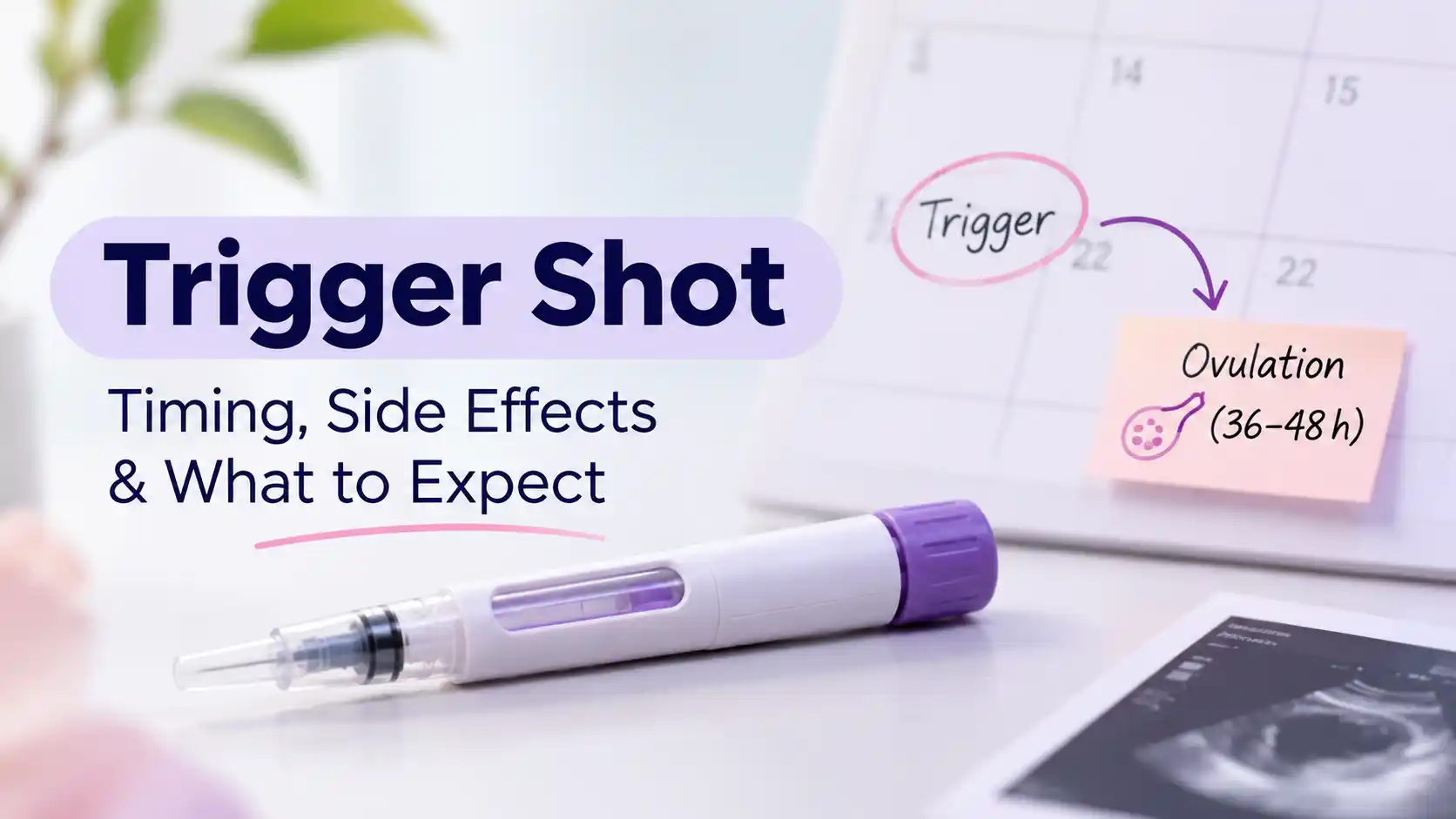
Table of contents37 sections
The timing matters. With an hCG-based trigger, ovulation usually occurs about 36 to 48 hours after the injection. During IVF, clinics commonly schedule egg retrieval about 34 to 36 hours after the trigger, before ovulation occurs.
The days around the trigger and egg retrieval can also bring bloating, pelvic pressure, and abdominal discomfort. Planning ahead, wearing comfortable clothes, and following your clinic’s recovery instructions can make this part of treatment easier.
The trigger shot can also affect pregnancy test results. Because hCG injections contain the same hormone that pregnancy tests detect, testing too early may produce a positive result even when pregnancy has not occurred.
What Is a Trigger Shot?
A trigger shot is a hormone injection that helps complete egg maturation and prepares the body for ovulation.
During a natural menstrual cycle, the pituitary gland releases a surge of luteinizing hormone (LH). This surge signals the mature follicle to release its egg.
Fertility medications can help several follicles develop during a treatment cycle. However, the eggs still need a final signal to mature. A trigger shot provides that signal or stimulates the body to produce it.
Doctors use trigger shots to:
- Complete the final stage of egg maturation.
- Trigger ovulation at a predictable time.
- Schedule IUI or timed intercourse.
- Prepare eggs for collection during IVF Process.
A trigger shot does not guarantee ovulation or pregnancy. It helps your fertility team control the timing of the next step.
What Does a Trigger Shot Do in IVF, IUI, and Timed Intercourse?
The purpose of the injection depends on your treatment plan. Your doctor chooses the timing based on ultrasound findings, follicle development, hormone levels, and your response to stimulation medication.
Trigger Shot for IVF
During IVF, fertility medications help the ovaries develop multiple follicles. Once the follicles reach an appropriate stage, the doctor schedules the trigger shot.
The injection helps the eggs complete their final maturation before collection. Your clinic usually schedules egg retrieval about 34 to 36 hours after an hCG trigger. The team collects the eggs before the follicles release them through ovulation.
The timing is important. If ovulation happens before retrieval, the clinic may not be able to collect the eggs as planned.
The physical discomfort around this stage often comes from the enlarged, stimulated ovaries rather than the trigger injection alone. You may notice bloating, pelvic heaviness, or discomfort when bending or moving quickly. These symptoms can make ordinary activities feel harder than usual.
A little preparation can make trigger and retrieval days easier:
- Set an alarm for the exact trigger time and keep your written instructions nearby. Prepare the medication and supplies as your clinic directs.
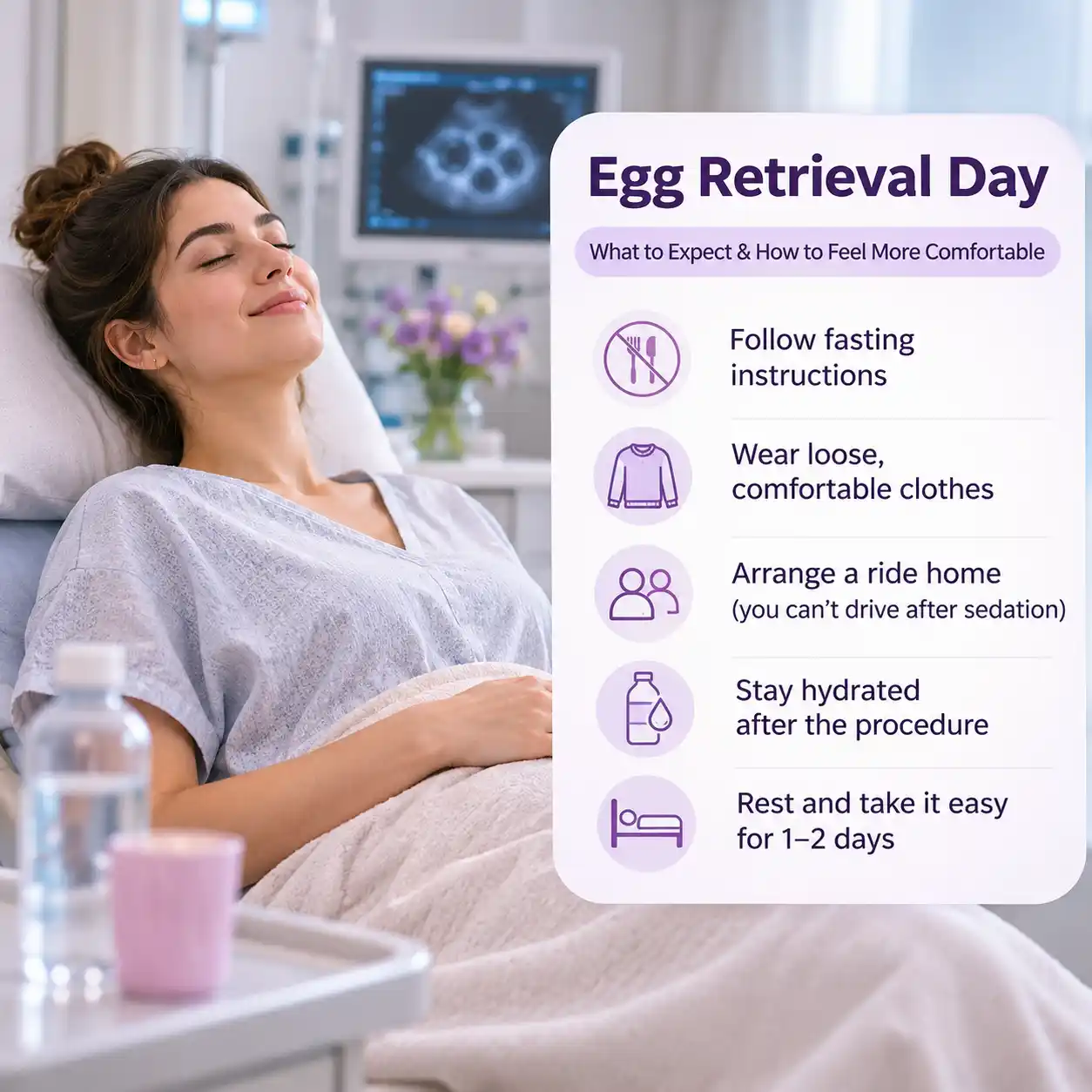
- Wear loose, comfortable clothes for your retrieval appointment. Tight waistbands can feel uncomfortable when your abdomen is bloated.
- Follow the clinic’s fasting instructions before retrieval. The required fasting period can vary, so use your clinic’s exact cutoff time rather than a general online rule.
- Arrange for a responsible adult to take you home after the procedure. Sedation or anesthesia can affect your alertness and ability to drive.
- Keep the rest of retrieval day free of work, errands, and strenuous plans. Most patients need time to rest after the procedure.
The retrieval itself usually takes place under sedation or anesthesia, so you should not feel the procedure. Afterward, mild to moderate cramping, pressure, or temporary nausea can occur. Your recovery team will assess your discomfort and explain which pain relief and other care steps are appropriate.
Trigger Shot for IUI
During intrauterine insemination (IUI), the trigger shot helps your doctor predict when ovulation will occur.
The clinic usually schedules insemination before the expected release of the egg. With an hCG trigger, ovulation typically occurs about 36 to 48 hours after injection.
Many clinics schedule IUI around 24 to 36 hours after the trigger, but the exact timing depends on the treatment protocol and monitoring results.
Trigger Shot for Timed Intercourse
Doctors may also use a trigger shot when you plan to conceive through intercourse rather than IUI.
The injection helps predict the fertile window. Your clinic may recommend intercourse on the day of the injection and the following day, depending on your treatment plan.
Your clinic may recommend intercourse on the evening of the trigger injection and again the following day or around 24–36 hours later. The exact schedule varies between treatment protocols and depends on follicle development and the timing of expected ovulation. Always follow your fertility team's instructions rather than using a general timing schedule.
Follow your clinic's instructions because the ideal timing can vary between patients.
How Does a Trigger Shot Work?
The trigger shot works by activating the hormonal signals involved in final egg maturation and ovulation.
Most trigger shots use one of two approaches.
1. hCG Trigger Shot
Human chorionic gonadotropin (hCG) acts in a similar way to luteinizing hormone (LH). It activates the LH receptor in the ovary and helps the egg resume meiosis, complete its final maturation, and prepare for ovulation.
Examples include:
- Ovidrel, which contains recombinant hCG.
- Pregnyl, which contains urinary-derived hCG.
Because hCG remains in the body longer than the natural LH surge, it can also increase the risk of ovarian hyperstimulation syndrome (OHSS) in susceptible patients.
2. GnRH Agonist Trigger
A gonadotropin-releasing hormone (GnRH) agonist, such as leuprolide (Lupron), works differently.
Instead of supplying hCG, it stimulates the pituitary gland to release the body's own LH and follicle-stimulating hormone (FSH). This creates a hormonal surge that helps complete egg maturation.
Doctors may use a GnRH agonist trigger in selected IVF protocols, particularly when a patient has a higher risk of OHSS.
What Is a Dual Trigger?
A dual trigger combines a GnRH agonist with hCG. Doctors may use this approach in selected IVF cycles when they want to support final egg maturation through both hormonal pathways.
However, a dual trigger is not suitable for every patient. Because it includes hCG, it does not remove the risk of OHSS. The 2025 ESHRE guideline advises against routinely adding hCG to a GnRH agonist trigger in high responders.
Ovidrel vs. Pregnyl vs. Lupron: What Is the Difference?
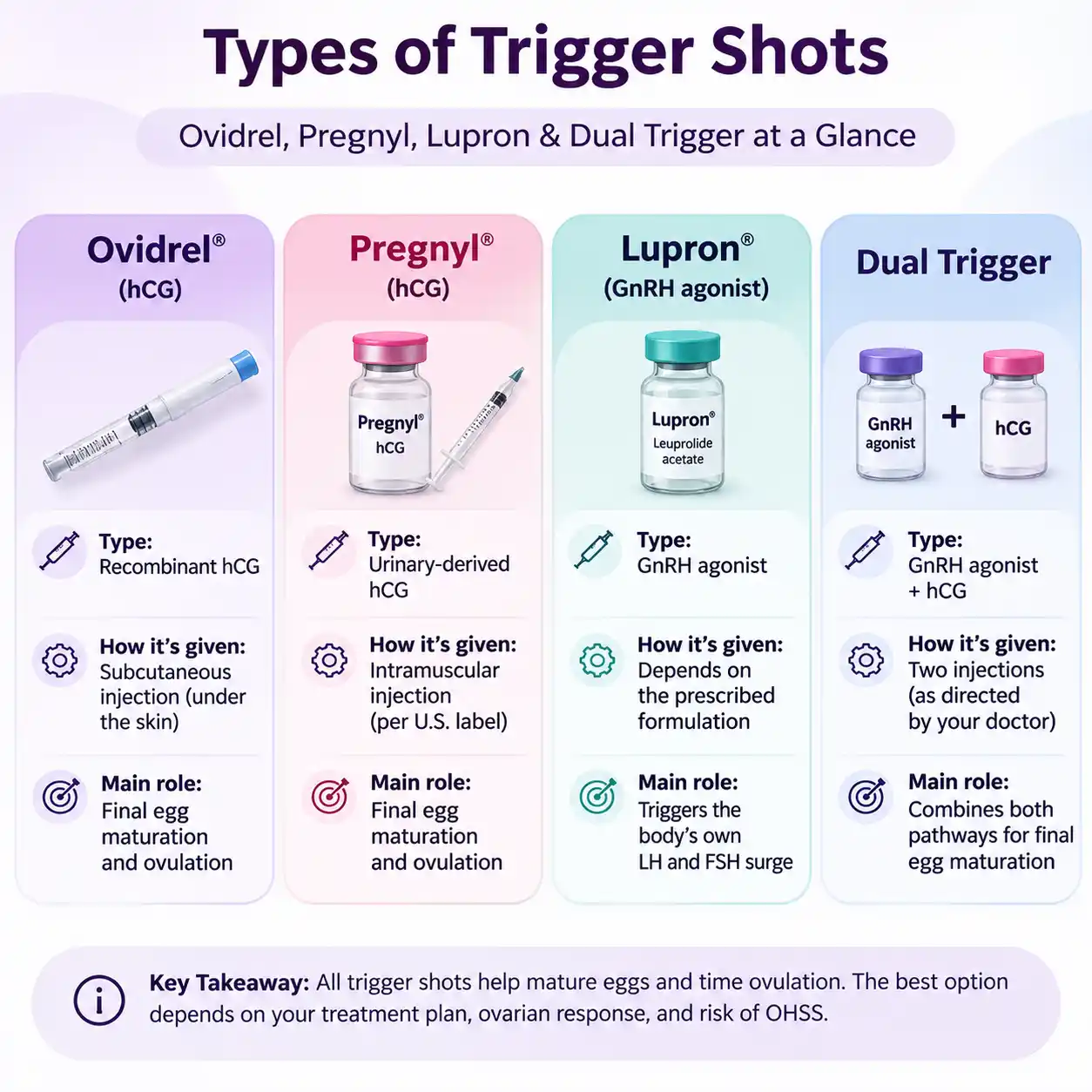
Doctors choose the trigger medication based on your treatment protocol, ovarian response, and risk of complications.
| Medication | Type | Common administration | Main role |
|---|---|---|---|
| Ovidrel | Recombinant hCG | Subcutaneous injection | Final egg maturation and ovulation |
| Pregnyl | Urinary-derived hCG | Intramuscular injection in the U.S. product label | Final egg maturation and ovulation |
| Lupron | GnRH agonist | Route depends on the prescribed formulation and protocol | Stimulates the body's own LH and FSH surge |
| Dual trigger | GnRH agonist plus hCG | Depends on the medications used | Combines both hormonal approaches |
Ovidrel and Pregnyl both provide hCG, but they differ in how manufacturers produce and supply them. Ovidrel contains recombinant hCG and comes as a prefilled injection. The U.S. Pregnyl product comes as a powder that requires reconstitution before intramuscular injection.
The main clinical difference between hCG and GnRH agonist triggers is their effect on OHSS risk. In suitable IVF antagonist cycles, a GnRH agonist trigger combined with a freeze-all plan can reduce the risk of severe OHSS. Your doctor must decide whether this approach is appropriate for your cycle.
When Should You Take Ovidrel?
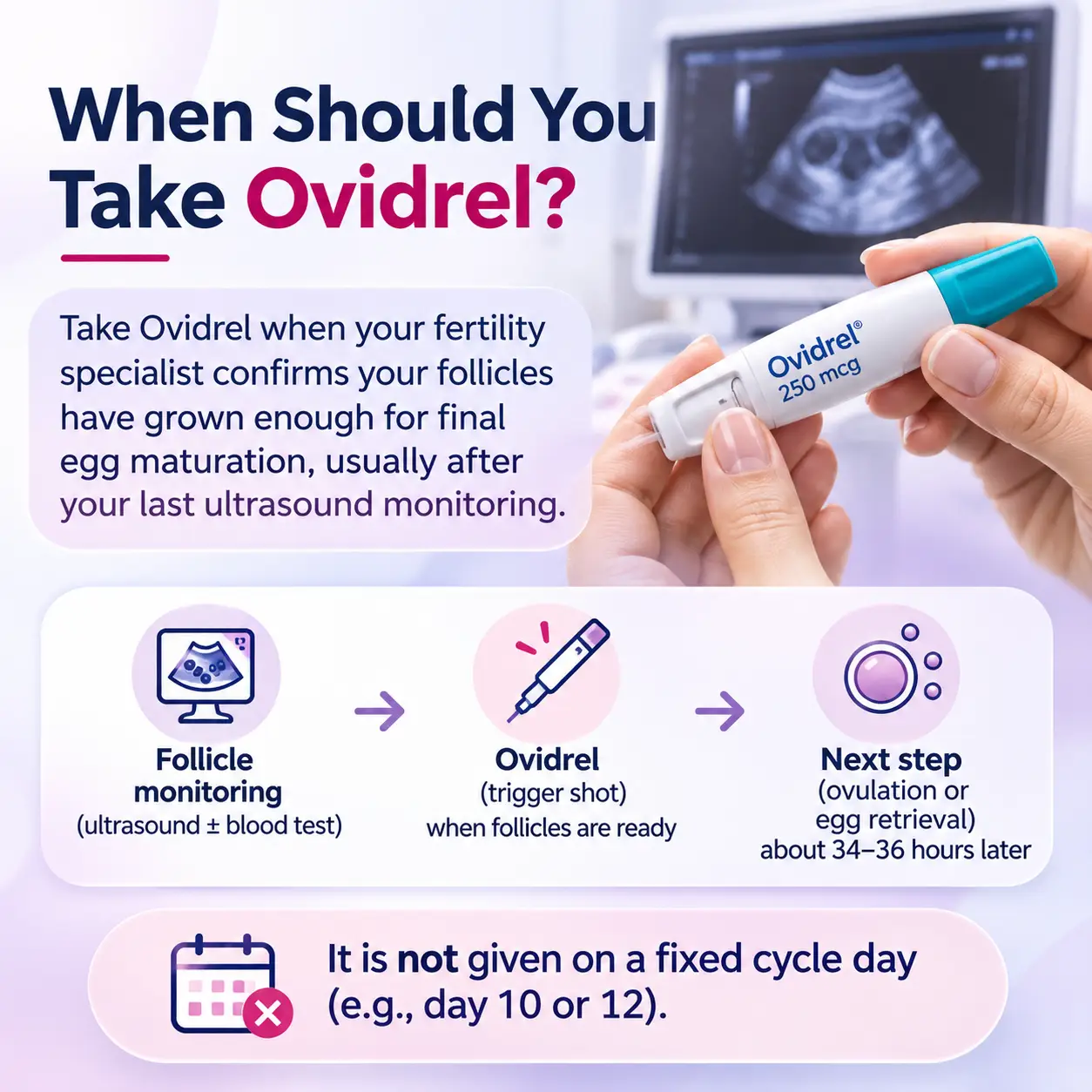
Ovidrel should be injected when your fertility specialist confirms that your follicles have developed sufficiently for final egg maturation. It is not given on a fixed menstrual cycle day, such as day 10 or day 12. Your doctor determines the timing using ultrasound monitoring and, when needed, blood estradiol levels.
During IVF, Ovidrel is generally scheduled after your final follicular monitoring appointment. The US prescribing information recommends administering the 250 mcg dose one day after the last FSH injection, once adequate follicular development has been confirmed. European Ovitrelle product information describes administration 24–48 hours after the last FSH or hMG dose. Your clinic may adjust the schedule according to your treatment protocol and ovarian response.
Once your clinic gives you an exact injection time, follow it carefully. If you miss the scheduled time, contact your fertility team immediately rather than adjusting the timing or repeating the dose yourself.
When Do You Ovulate After a Trigger Shot?
After an hCG trigger shot, ovulation usually occurs within 36 to 48 hours.
The injection starts the final hormonal process that leads to follicle rupture and egg release. However, the exact timing can vary.
Your doctor may use ultrasound and hormone measurements to decide when to give the injection and when to schedule intercourse or IUI.
In IVF, the clinic usually collects eggs before the expected time of ovulation. This is why egg retrieval often takes place about 34 to 36 hours after an hCG trigger.
Can You Ovulate 12 Hours After a Trigger Shot?
Ovulation 12 hours after an hCG trigger is earlier than the usual expected timing.
Most patients ovulate around 36 to 48 hours after an hCG injection. However, the timing may differ if the body had already started its natural LH surge before the injection.
If you think you ovulated earlier than expected, contact your fertility clinic. Your doctor can review your ultrasound findings, hormone results, and treatment timeline.
Do not rely on ovulation symptoms alone to determine whether the follicle has ruptured.
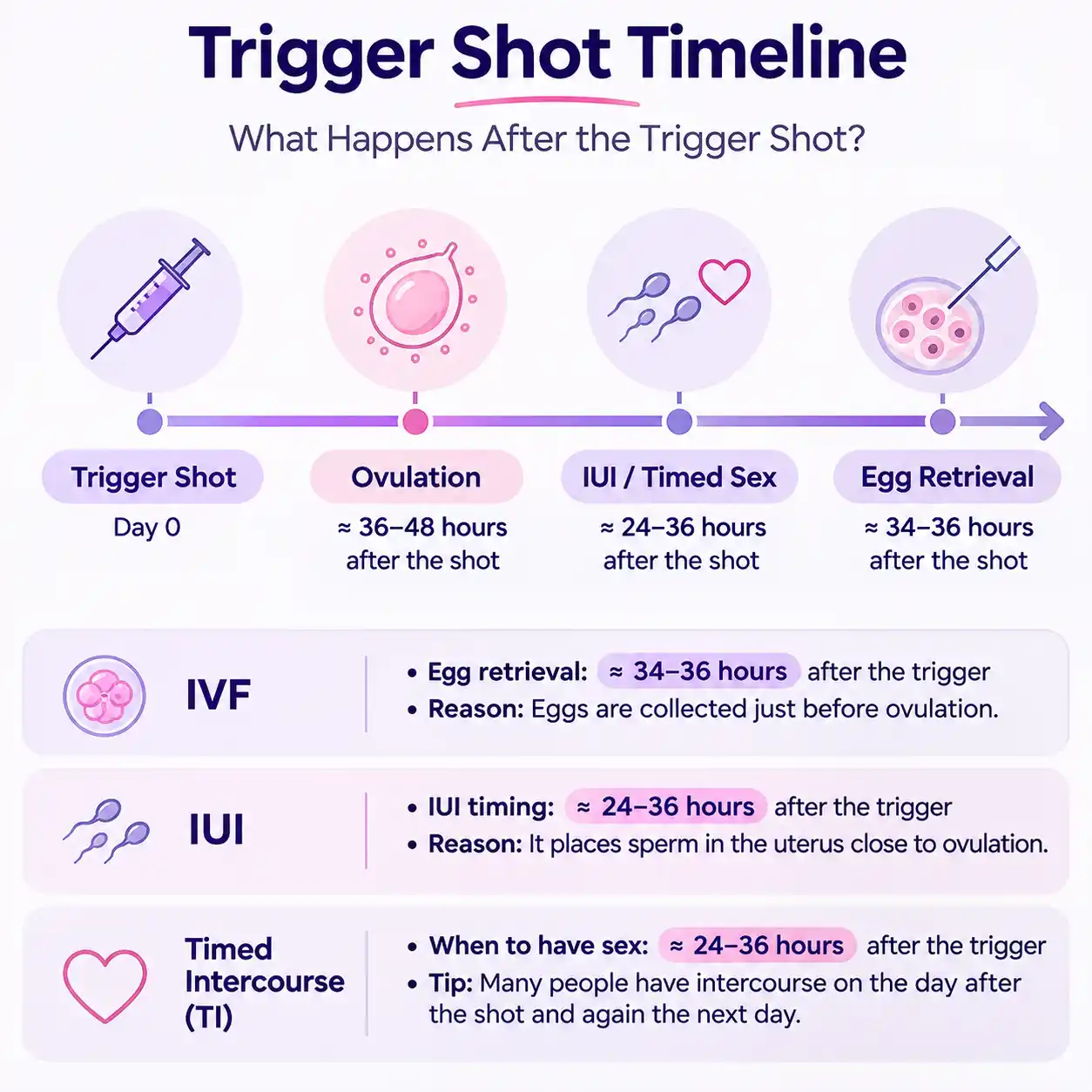
Trigger Shot Timeline: What Happens After the Injection?
The following timeline shows common treatment schedules. Your clinic may use a different schedule based on your medication and response.
| Time or stage | What usually happens |
|---|---|
| Trigger shot | You receive the injection at the exact time prescribed by your clinic. |
| About 24–36 hours later | Many clinics schedule IUI within this window. |
| About 34–36 hours later | IVF clinics commonly perform egg retrieval after an hCG trigger. |
| About 36–48 hours later | Ovulation usually occurs after an hCG trigger in ovulation-induction cycles. |
| After IUI or embryo transfer | Your clinic schedules a pregnancy test based on your treatment protocol. |
These timings are general estimates, not instructions for changing your treatment schedule. Your clinic's timing takes priority.
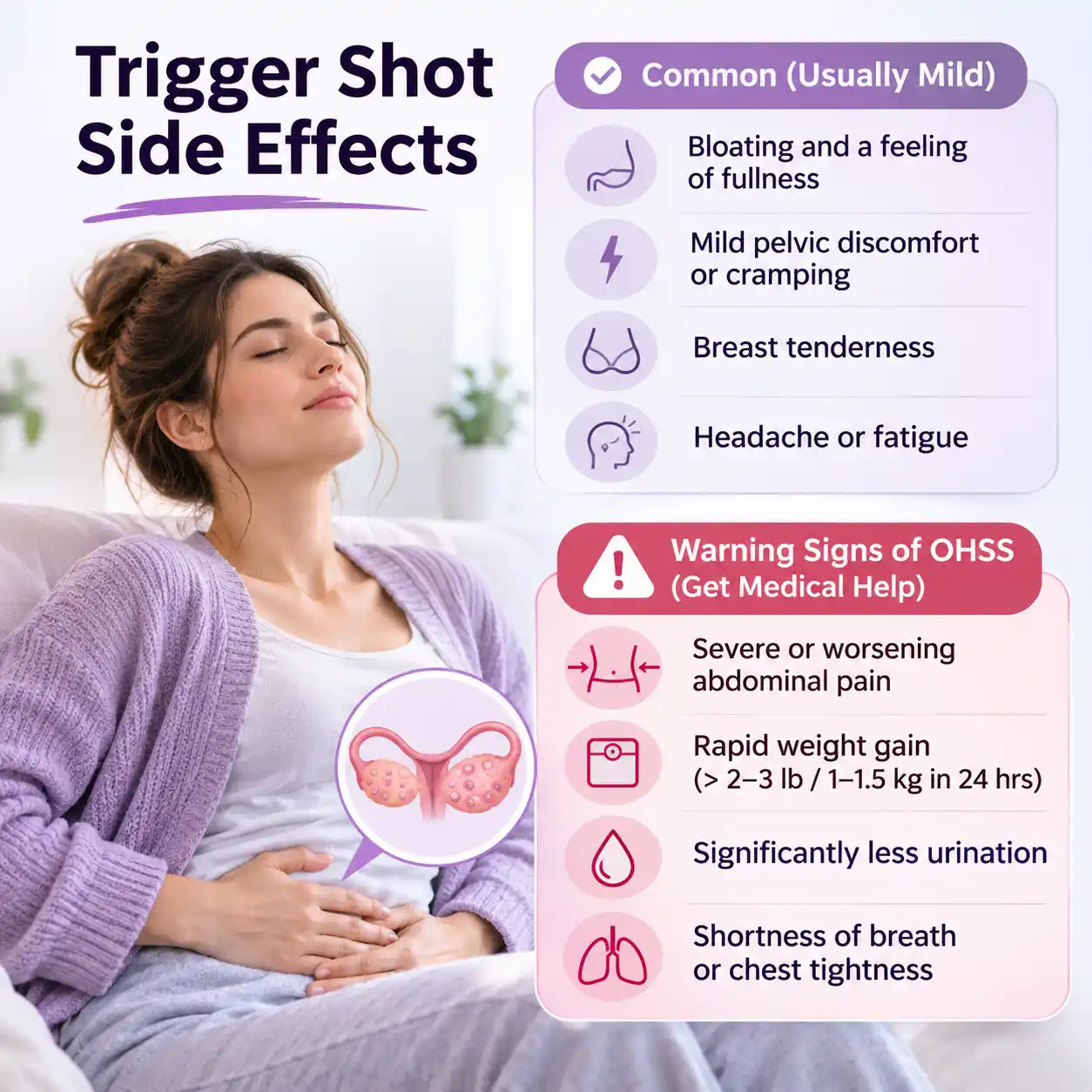
What Are the Side Effects of a Trigger Shot?
Most patients tolerate trigger shots without serious problems. Some experience mild side effects, especially after an hCG injection.
Common side effects include:
- Pain, redness, or bruising at the injection site.
- Abdominal discomfort or bloating.
- Nausea.
- Headache.
- Breast tenderness.
- Fatigue.
These symptoms may also result from ovarian stimulation medication, so they do not always come directly from the trigger shot.
Bloating and pelvic heaviness can feel more noticeable as the ovaries enlarge during stimulation. Loose clothing, a lighter schedule, and regular fluids can help you manage everyday discomfort. You do not need to force large amounts of water or start electrolyte drinks unless your care team recommends them.
After egg retrieval, give yourself time to recover. Rest for the remainder of the day and follow the clinic’s instructions about pain relief. Gentle walking is usually different from strenuous exercise: your clinic may allow short, easy walks while advising you to avoid heavy lifting, running, and intense workouts until you recover.
Some fertility centers also allow a heating pad for mild abdominal cramps after retrieval. Check your own clinic’s aftercare instructions before using one. If you feel nauseated after sedation, start with fluids or a light snack only when your recovery team says you can eat and drink.
Ask your clinic which pain reliever is suitable for you. Do not start a pain medication, stool softener, or other treatment on your own, especially if your team has given you specific restrictions.
Can a Trigger Shot Cause Ovarian Hyperstimulation Syndrome (OHSS)?
Yes. hCG trigger shots can contribute to ovarian hyperstimulation syndrome, especially in patients whose ovaries respond strongly to stimulation.
OHSS occurs when the ovaries become enlarged and fluid moves into areas such as the abdomen. Mild cases may cause bloating and abdominal discomfort. Severe cases can lead to serious complications.
Contact your fertility clinic promptly if you notice:
- Severe or worsening abdominal or pelvic pain.
- Rapid weight gain.
- Marked abdominal swelling.
- Persistent nausea or vomiting.
- Reduced urination.
- Shortness of breath.
Seek urgent medical attention for severe symptoms, particularly difficulty breathing or severe abdominal pain.
Do not assume that worsening swelling or pain is ordinary post-retrieval discomfort. Rest, fluids, or a heating pad cannot treat significant OHSS. Your clinic may need to assess your symptoms, check your fluid balance, and arrange further monitoring.
Your clinic may monitor you after the trigger shot because OHSS can develop or worsen in the days following treatment. The risk and prevention plan depend on your ovarian response and the type of trigger used.
What Are the Chances of Getting Pregnant With a Trigger Shot?
A trigger shot can improve the timing of ovulation, but it does not guarantee pregnancy.
Your chances depend on several factors, including:
- Your age and ovarian reserve.
- The cause of infertility.
- The number and maturity of your follicles.
- Sperm quality.
- Fallopian tube health, particularly during timed intercourse or IUI.
- Whether you are undergoing IUI or IVF.
- Embryo quality and other factors related to implantation.
The injection helps coordinate ovulation or egg retrieval. It does not correct every cause of infertility.
Your fertility specialist can give you a more meaningful estimate after reviewing your diagnosis, test results, and treatment plan.
How Long Does a Trigger Shot Stay in Your System?
The time a trigger shot remains detectable depends on the medication, dose, route of administration, and individual response.
How Long Does Ovidrel Stay in Your System?
Ovidrel contains recombinant hCG. Its average terminal half-life after subcutaneous injection is about 29 hours.
A half-life does not mean that the medication disappears completely after 29 hours. The body needs several half-lives to eliminate most of a drug.
The European product information warns that Ovitrelle, the European brand of choriogonadotropin alfa, may interfere with urine or blood pregnancy tests for up to 10 days after injection.
How Long Does Pregnyl Stay in Your System?
Pregnyl contains urinary-derived hCG. Its detection time can vary between patients.
An older study involving 34 patients undergoing IVF found that injected hCG remained detectable in serum for up to 14 days in some patients. This study does not mean every patient will test positive for 14 days, but it shows why early pregnancy testing can be misleading.
The important point is that hCG from a trigger shot can remain detectable after the expected ovulation date.
When Can You Take a Pregnancy Test After a Trigger Shot?
Follow the pregnancy test date given by your fertility clinic.
An hCG trigger shot can cause a positive urine or blood pregnancy test because the test detects the medication as well as hCG produced during pregnancy. Testing too early may therefore give you a positive result that does not indicate pregnancy.
An early negative result can also be misleading. If you test before the date your clinic recommends, your hCG level may still be too low for a home test to detect. A negative result before the scheduled test does not necessarily rule out pregnancy.
For IUI, many clinics schedule testing about 14 days after insemination. After IVF, the clinic sets the test date based on the embryo transfer and treatment protocol.
Do not stop progesterone or other prescribed fertility medication because of an early home test or spotting. Continue your medication until your clinic tells you otherwise.
A blood beta-hCG test provides a more useful clinical result than repeated early home tests. Your doctor may also repeat the blood test to assess how the hCG level changes over time.
What Does “Testing Out the Trigger” Mean?
Testing out the trigger is an informal approach some patients use after an hCG injection.
They take home pregnancy tests over several days and watch the test line become lighter as the injected hCG leaves the body. If the line later becomes darker, they may wonder whether their body has started producing pregnancy-related hCG.
However, this method has important limitations.
- Home pregnancy tests differ in sensitivity.
- Urine concentration changes throughout the day.
- A lighter or darker line does not provide a reliable measurement of hCG.
- A positive result can still come from the trigger medication.
- Line progression cannot confirm a viable pregnancy.
A faint line several days after an embryo transfer may still reflect injected hCG, depending on the trigger dose and timing. A darker line on the next test does not prove pregnancy either, because urine concentration and test sensitivity can affect the result.
Testing out the trigger is not a validated way to diagnose pregnancy. It should never replace the blood test scheduled by your fertility clinic.
If repeated home testing makes you anxious, waiting for your clinic's scheduled test may be a better option.
Does Ovidrel Need to Be Refrigerated?
Yes. The Ovidrel prefilled syringe should generally stay refrigerated at 2–8°C (36–46°F).
According to the U.S. product information, patients may store the prefilled syringe at room temperature up to 25°C (77°F) for no more than 30 days. The European product information gives similar room-temperature guidance.
Keep the medication in its original package and protect it from light. Do not freeze it.
When Should You Take Ovidrel Out of the Fridge?
You do not need to leave Ovidrel outside the refrigerator for hours before injection.
Follow the storage instructions on your own package and the instructions from your clinic or pharmacist. If your medication has been exposed to heat, frozen, or left outside its recommended storage conditions for an uncertain period, contact your pharmacist or clinic before using it.
Do not assume that every fertility injection has the same storage requirements.
Frequently Asked Questions About Trigger Shots
Is a trigger shot painful?
Most patients describe the injection as manageable. Ovidrel uses a subcutaneous injection, while the U.S. Pregnyl product requires an intramuscular injection after reconstitution. You may feel brief discomfort, soreness, or tenderness at the injection site.
What should I do if I miss the scheduled trigger shot time?
Contact your fertility clinic or its after-hours/on-call team as soon as possible. Trigger timing affects ovulation, IUI, and egg retrieval schedules. Do not take the injection late, repeat it, or change the treatment schedule unless your clinic tells you to.
If your usual doctor is away, ask whether the clinic has a covering physician or an on-call nurse. Another clinician may need to review your current ultrasound and hormone results before advising you. Do not use leftover medication or seek a replacement prescription without making sure the clinician has reviewed your current cycle.
If you have PCOS, do not rely on an ovulation predictor kit alone to decide when to inject or assume that ovulation has occurred. Some people with PCOS have higher baseline LH levels, which can cause false-positive results on urine LH tests. Your clinic may use ultrasound and blood tests to guide timing.
What if I think I injected the trigger shot incorrectly?
Contact your clinic as soon as possible. Tell the team which medication you used, the time of injection, how you administered it, and whether any medication leaked or remained in the syringe.
Do not give yourself another dose unless your clinic specifically tells you to.
Can a trigger shot make a pregnancy test positive?
Yes, if the trigger contains hCG, such as Ovidrel or Pregnyl. A pregnancy test may detect the injected hormone and show a positive result even when pregnancy has not occurred.
A GnRH agonist-only trigger does not contain hCG, but a dual trigger does.
Do follicles continue to grow after a trigger shot?
The trigger shot mainly supports final egg maturation and the events leading to ovulation. It does not replace the earlier follicle-growth phase of ovarian stimulation.
Your clinic decides when to give the trigger based on follicle development and monitoring results.
How long after Ovidrel do you ovulate?
Ovulation usually occurs about 36 to 48 hours after an hCG trigger such as Ovidrel. Your individual timing may differ, so follow your clinic's instructions for intercourse or IUI.
Is Ovidrel the same as Pregnyl?
No. Both contain hCG, but Ovidrel contains recombinant hCG, while Pregnyl contains urinary-derived hCG. Their formulations and administration instructions also differ.
When should I take Ovidrel during my IVF cycle?
After your fertility clinic confirms adequate follicular development through ultrasound and sometimes blood tests. It is not tied to a particular menstrual cycle day.
Should I take Ovidrel in the morning or at night?
The exact time depends on your treatment schedule. Many IVF clinics prescribe an evening injection to coordinate egg retrieval, but you should follow the exact time given by your clinic.
What happens if I take Ovidrel at the wrong time?
Contact your fertility clinic immediately. The timing affects final egg maturation and the scheduled egg retrieval or ovulation. Do not repeat the dose or adjust your procedure schedule without medical instructions.
Final Thoughts
A trigger shot helps fertility specialists coordinate final egg maturation, ovulation, IUI, and IVF egg retrieval. The medication, dose, and timing depend on your treatment plan and ovarian response.
The days around the trigger and egg retrieval can feel physically demanding. Prepare for the exact injection time, follow fasting instructions before retrieval, arrange a ride home, and give yourself time to recover. Mild cramping and bloating can occur, but worsening pain, marked swelling, vomiting, reduced urination, or breathing problems need medical attention.
At VitaLife, we help patients understand fertility treatment options and coordinate care with partner clinics. Our team can help you understand the steps involved in IVF and other fertility treatments in Iran.
Medical References
- ASRM: Fertility Evaluation of Infertile Women, Committee Opinion
- ESHRE: Ovarian Stimulation for IVF/ICSI, 2025 Guideline Update
- DailyMed: Ovidrel Prescribing Information
- European Medicines Agency: Ovitrelle Product Information
- DailyMed: Pregnyl Prescribing Information
- Damewood et al. (1989): Disappearance of Exogenously Administered Human Chorionic Gonadotropin
- NYU Langone Fertility Center: The Egg Retrieval Process
- Emory School of Medicine: Oocyte (Egg) Retrieval
- RCOG: Ovarian Hyperstimulation Syndrome
- IVFAustralia: After-Hours Patient Information
Comments 0
Share a question or experience related to this article. Comments appear after review by our team.
No comments yet. You can start the conversation.