Fresh Embryo Transfer in IVF
Fresh embryo transfer is an IVF option in which an embryo is transferred to the uterus a few days after egg retrieval, without being frozen first. This guide explains when fresh transfer is used, how timing and hormone levels affect the decision, its benefits and risks, success factors, and how it compares with frozen embryo transfer.
By VitaLife Editorial TeamFertility & Family-Building Editorial Team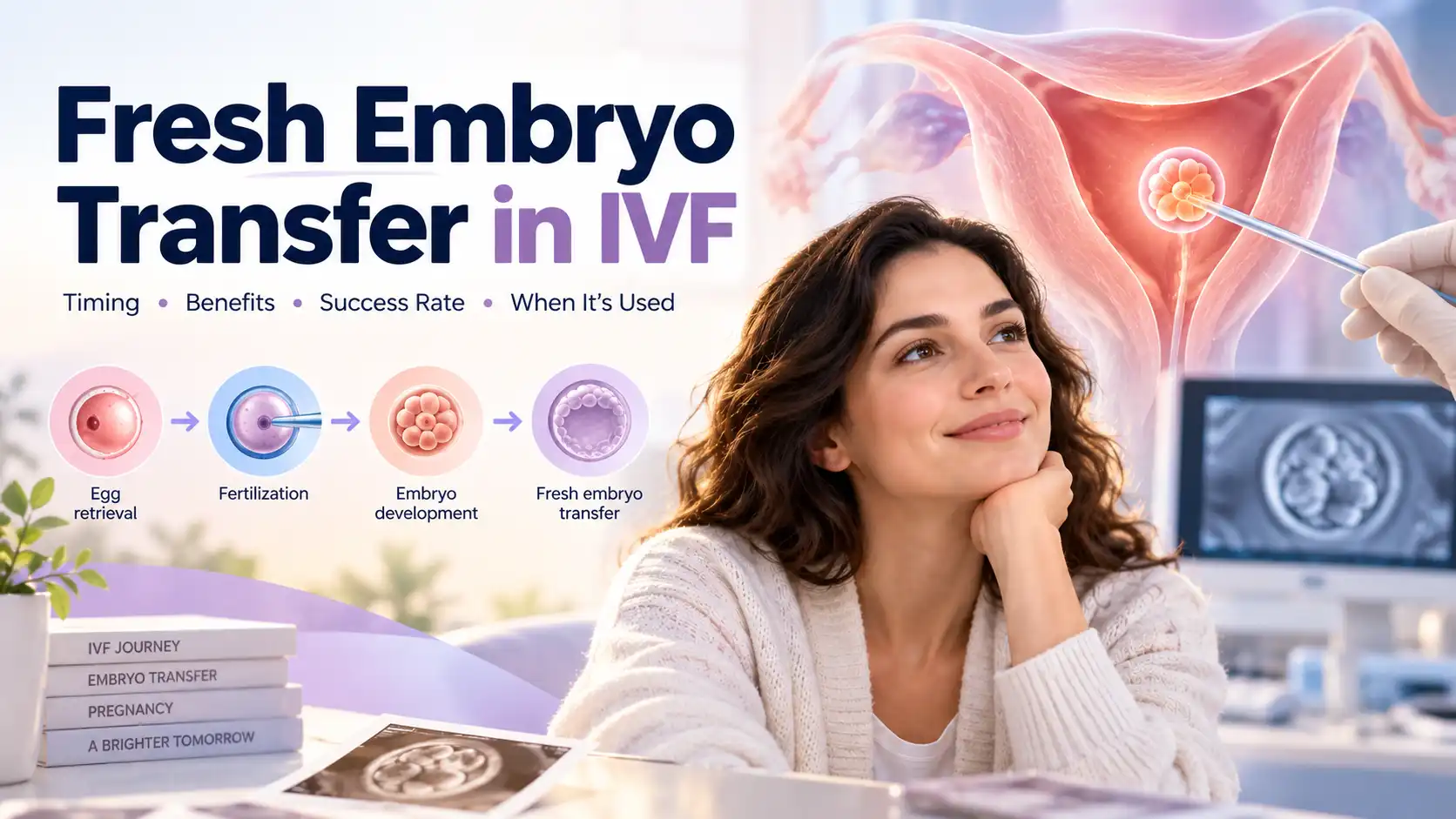
Table of contents59 sections
For some patients, this can be a straightforward way to move from egg retrieval to embryo transfer without waiting for another cycle. For others, freezing the embryo and transferring it later may give the medical team more flexibility.
So, is fresh embryo transfer better than frozen? There is no single answer. The right approach depends on factors such as hormone levels, the uterine lining, embryo development, the risk of ovarian hyperstimulation syndrome (OHSS), whether genetic testing is planned, and the patient's individual treatment plan.
At VitaLife, we look at these factors before deciding whether a fresh transfer is appropriate rather than treating fresh or frozen transfer as a fixed choice.
Podcast version
Prefer to listen? Play the audio version of this page.
What Is a Fresh Embryo Transfer?
A fresh embryo transfer means transferring an embryo into the uterus during the same IVF cycle in which the eggs were retrieved.
The basic process looks like this:
Ovarian stimulation → Egg retrieval → Fertilization → Embryo development → Fresh embryo transfer
The embryo is usually transferred 2 to 6 days after egg retrieval, depending on how the embryos are developing and the transfer plan.
Unlike a frozen embryo transfer, the embryo is not vitrified and stored before transfer.
Fresh vs. Frozen Embryo Transfer at a Glance
| Feature | Fresh embryo transfer | Frozen embryo transfer |
|---|---|---|
| Egg retrieval | Same cycle | Previous cycle |
| Embryo freezing | No | Yes |
| Transfer timing | Usually a few days after retrieval | Later cycle |
| Hormone levels | Still affected by stimulation | More time to settle |
| PGT | Generally not completed before transfer | Can be performed before transfer |
| Uterine preparation | During stimulation cycle | Prepared separately |
| Timing flexibility | Lower | Higher |
| Need for another transfer cycle | No | Yes |
How Does Fresh Embryo Transfer Work?
A fresh transfer is not a separate treatment from IVF Process. It is the final part of a particular IVF cycle.
After ovarian stimulation, the eggs are collected and sent to the embryology laboratory. The eggs are then fertilized using conventional IVF or ICSI. The resulting embryos are monitored as they develop.
If the embryo reaches the proper stage and the patient's body is ready for transfer, the embryo can be placed into the uterus during the same cycle.
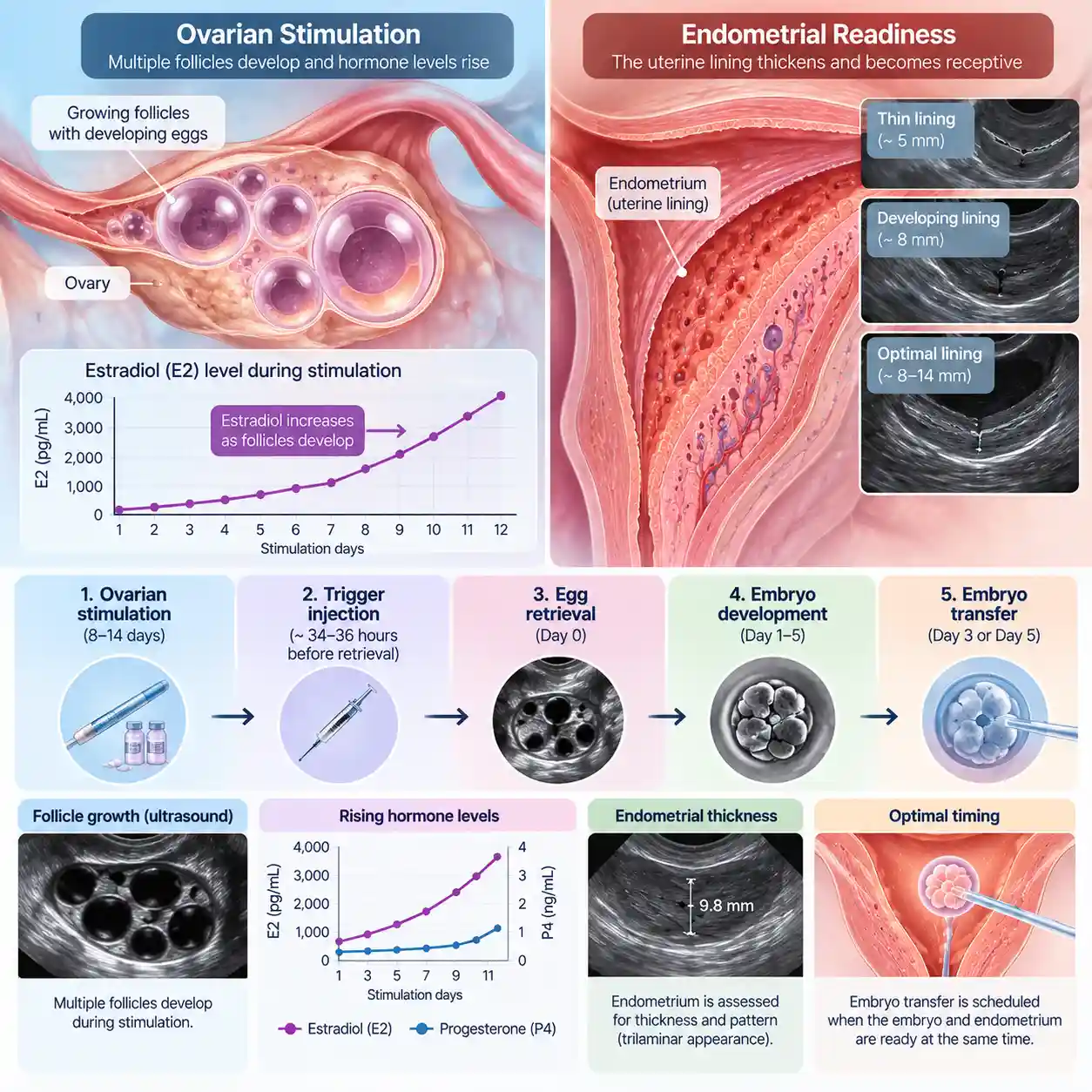
The Fresh Transfer Timeline
| IVF step | Typical timing |
|---|---|
| Ovarian stimulation | About 8–14 days |
| Trigger injection | 34–36 hours before retrieval |
| Egg retrieval | Day 0 |
| Fertilization | Same day |
| Early embryo development | Days 1–3 |
| Blastocyst development | Days 5–6 |
| Fresh embryo transfer | Usually Day 3 or Day 5, depending on the plan |
| Pregnancy blood test | Usually 9–14 days after transfer |
The exact timing is not identical for every patient.
The simple idea is that the embryo and the uterus need to be ready at the same time.
When Is Fresh Embryo Transfer Done?
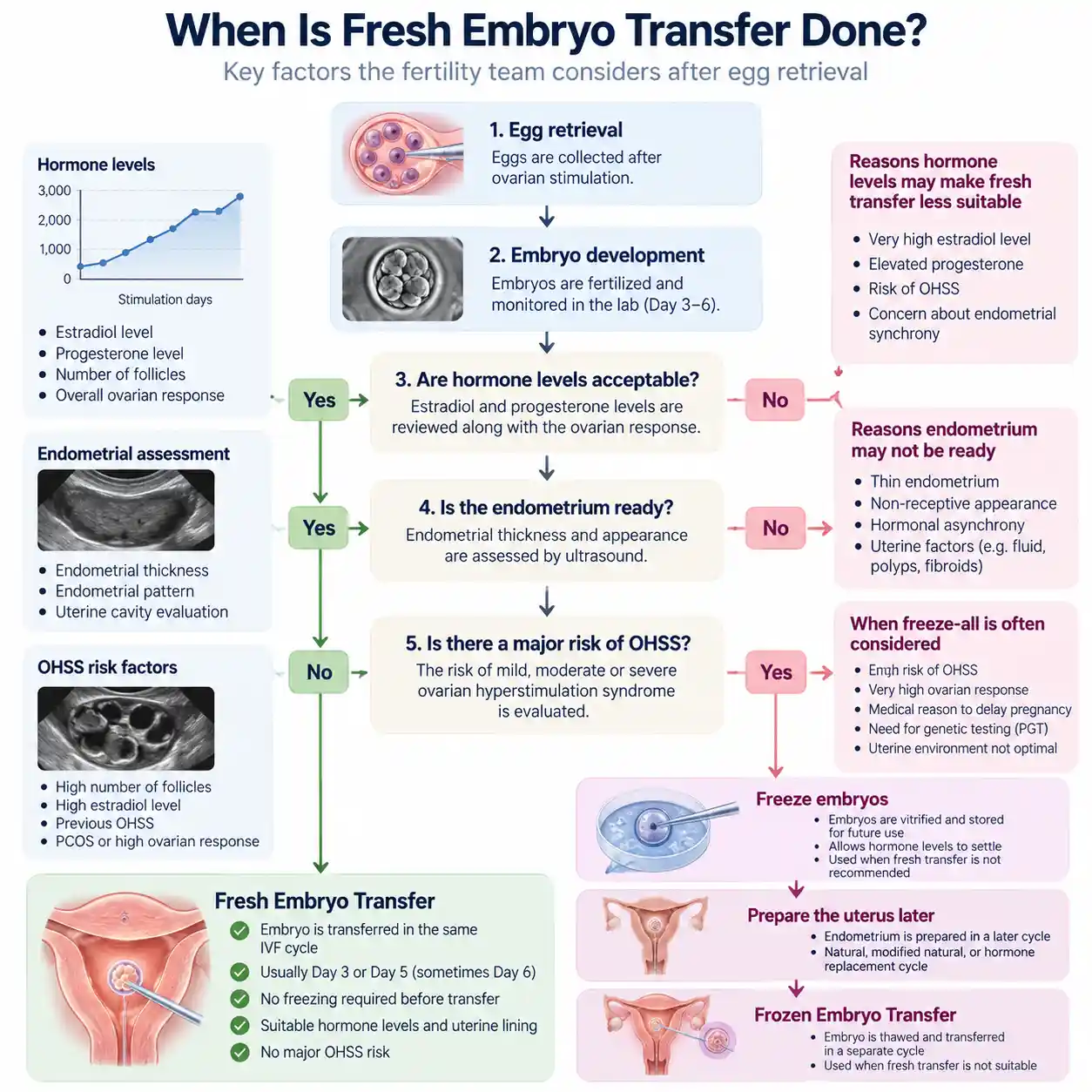
A fresh embryo transfer may be considered when the embryo is developing appropriately and there is no clear medical reason to delay the transfer.
Before recommending it, the fertility team may look at several factors.
1. Hormone Levels
Ovarian stimulation causes hormone levels to rise. In particular, estrogen levels can become much higher than they would be during a natural menstrual cycle.
The team may monitor these levels throughout stimulation and use them together with ultrasound findings to decide whether the cycle remains suitable for fresh transfer.
A high hormone level does not automatically mean that fresh transfer is impossible. The decision depends on the overall clinical picture.
The important point is that hormone levels are one part of the decision, not the only factor.
2. Endometrial Readiness
The embryo needs a suitable uterine lining for implantation.
During a fresh cycle, the endometrium develops while the ovaries are being stimulated. In some patients, the hormonal environment may not be considered ideal for immediate transfer.
If the team believes the uterine lining would be better prepared later, the embryos can be frozen and transferred in a future cycle.
3. Embryo Development
The embryo also needs to reach an appropriate stage.
Some embryos develop faster than others. By Day 5 or Day 6, some may reach the blastocyst stage, while others stop developing earlier.
The number and quality of embryos available can therefore affect the transfer plan.
4. Risk of OHSS
Ovarian hyperstimulation syndrome (OHSS) is a possible complication of ovarian stimulation.
When the risk of moderate or severe OHSS is high, delaying pregnancy can sometimes be part of the medical plan because pregnancy-related hormonal changes can make OHSS worse or prolong it.
In such cases, the embryos can be frozen and transferred later.
If OHSS is a concern, postponing transfer may be safer than continuing with a fresh cycle.
Read More: how to choose a fertility clinic
What Are the Benefits of Fresh Embryo Transfer?
Fresh transfer still has a place in modern IVF, even though frozen embryo transfer is now widely used.
1. Pregnancy Can Be Attempted in the Same Cycle
One of the clearest benefits of fresh embryo transfer is timing.
The embryo can be transferred only a few days after egg retrieval instead of waiting for a later cycle.
For some patients, avoiding another preparation cycle is an important advantage.
2. No Embryo Freezing Is Needed Before Transfer
The embryo does not need to go through vitrification and later warming before the transfer.
Modern vitrification is highly effective, but avoiding an additional laboratory step can still be relevant when deciding how a particular cycle should be managed.
3. The IVF Timeline Can Be Shorter
With a fresh transfer, egg retrieval and embryo transfer happen within the same treatment cycle.
For example:
Egg retrieval → embryo development → transfer
With frozen transfer, the pathway becomes:
Egg retrieval → embryo development → vitrification → storage → uterine preparation → warming → transfer
4. It May Be Appropriate for Selected Patients
Fresh transfer is not automatically better, but it can be a reasonable option when hormone levels, uterine conditions, embryo development and other individual factors are favorable.
At VitaLife, we consider these factors together rather than choosing fresh or frozen transfer simply because one method is used more often.
What Are the Risks or Limitations of Fresh Embryo Transfer?
Fresh transfer also has some important limitations.
Hormonal Changes During the Same Cycle
The ovaries have just been stimulated to produce multiple eggs. As a result, hormone levels can be very different from those in a natural cycle.
For some patients, this may influence the timing of embryo transfer.
Risk of OHSS
Patients who respond strongly to stimulation may have a higher risk of OHSS.
If pregnancy occurs during the same cycle, the hormonal changes associated with pregnancy can affect the course of OHSS.
This is one reason a freeze-all strategy may be recommended in selected patients.
Less Flexibility
Fresh transfer has a narrower window.
The embryo develops over several days, while the uterine environment is changing at the same time. A frozen embryo can instead be stored until the uterus is prepared in a later cycle.
Genetic Testing May Change the Plan
If embryos are going to undergo preimplantation genetic testing, fresh transfer is usually not the practical route because the laboratory needs time to biopsy the embryo and obtain the test result.
This leads to an important question.
Can You Do PGT Testing on Fresh Embryos?
In most IVF treatment plans, PGT-A or PGT-M cannot be completed and used for embryo selection within a standard fresh-transfer timeline.
At the blastocyst stage, a small number of cells can be removed from the embryo for biopsy. The embryo is then normally vitrified while the laboratory completes genetic testing.
The process generally looks like this:
Blastocyst → Biopsy → Vitrification → Genetic testing → Result → Frozen embryo transfer
This is one reason why patients planning PGT usually have a frozen embryo transfer rather than a fresh transfer.
PGT-A vs PGT-M
| Test | What it looks for | Typical reason for use |
|---|---|---|
| PGT-A | Abnormal chromosome number | To identify embryos with aneuploidy |
| PGT-M | A specific inherited condition | When a known genetic condition is a concern |
A euploid embryo is an embryo with the expected number of chromosomes based on the test.
If genetic testing is planned, the embryo usually needs to be frozen while the results are being processed.
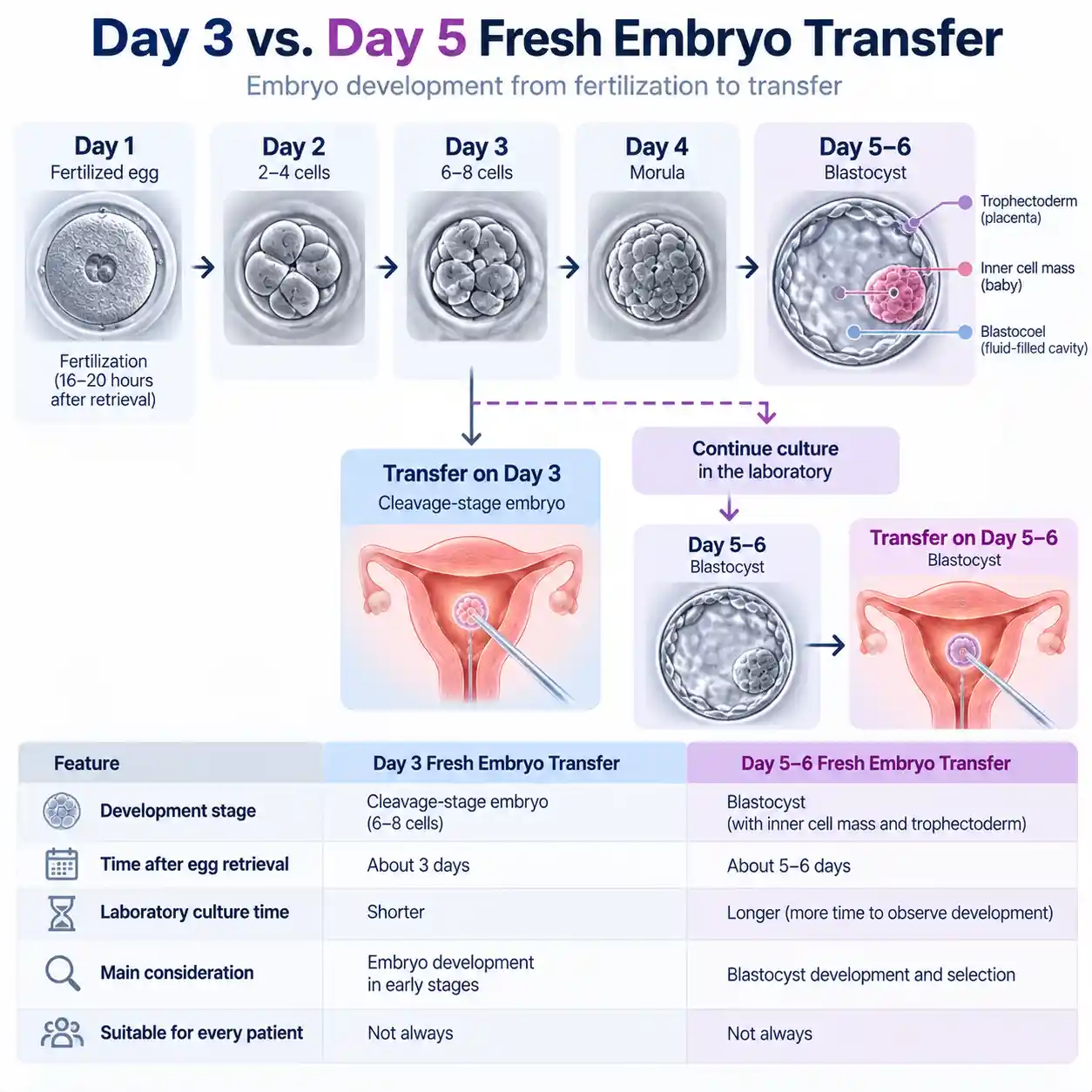
Day 3 Fresh Embryo Transfer vs Day 5 Fresh Embryo Transfer
Fresh transfer does not always mean transferring on the same day.
The embryo can be transferred at different stages of development.
3-Day Fresh Embryo Transfer
A 3 day fresh embryo transfer involves transferring an embryo at the cleavage stage, usually around Day 3 after fertilization.
At this stage, the embryo has undergone several rounds of cell division but has not yet reached the blastocyst stage.
Potential reason for Day 3 transfer
A clinic may consider a Day 3 transfer in some situations where continuing embryo culture to Day 5 may not be preferred.
However, the decision depends on the number and development of embryos and the laboratory's approach.
5-Day Fresh Embryo Transfer
A 5 day fresh embryo transfer transfers a blastocyst.
By Day 5, a normally developing embryo has formed a more complex structure with different cell groups.
The blastocyst contains:
- Inner cell mass — develops into the fetus
- Trophectoderm — develops into the placenta
- Blastocoel — the fluid-filled cavity
Because embryos are observed for several additional days, the laboratory has more information about which embryos continue developing.
Day 3 vs Day 5 Fresh Transfer
| Feature | Day 3 transfer | Day 5 transfer |
|---|---|---|
| Embryo stage | Cleavage-stage embryo | Blastocyst |
| Time after fertilization | About 3 days | About 5 days |
| More laboratory development time | No | Yes |
| Blastocyst selection | No | Yes |
| Suitable for every patient | No | No |
Day 5 transfer gives the laboratory more time to observe embryo development, but not every embryo will reach Day 5.
What About Day 6 Fresh Embryo Transfer?
Some embryos reach the blastocyst stage later than others.
A Day 6 embryo can still be a usable blastocyst if it reaches the appropriate stage and meets the laboratory's criteria.
However, Day 6 development is different from simply deciding to transfer every embryo on Day 6.
The embryology team evaluates the embryo's development and quality before deciding whether it is suitable for transfer or freezing.
The important factor is not simply the number "Day 6," but how the embryo developed and what it looks like at that stage.
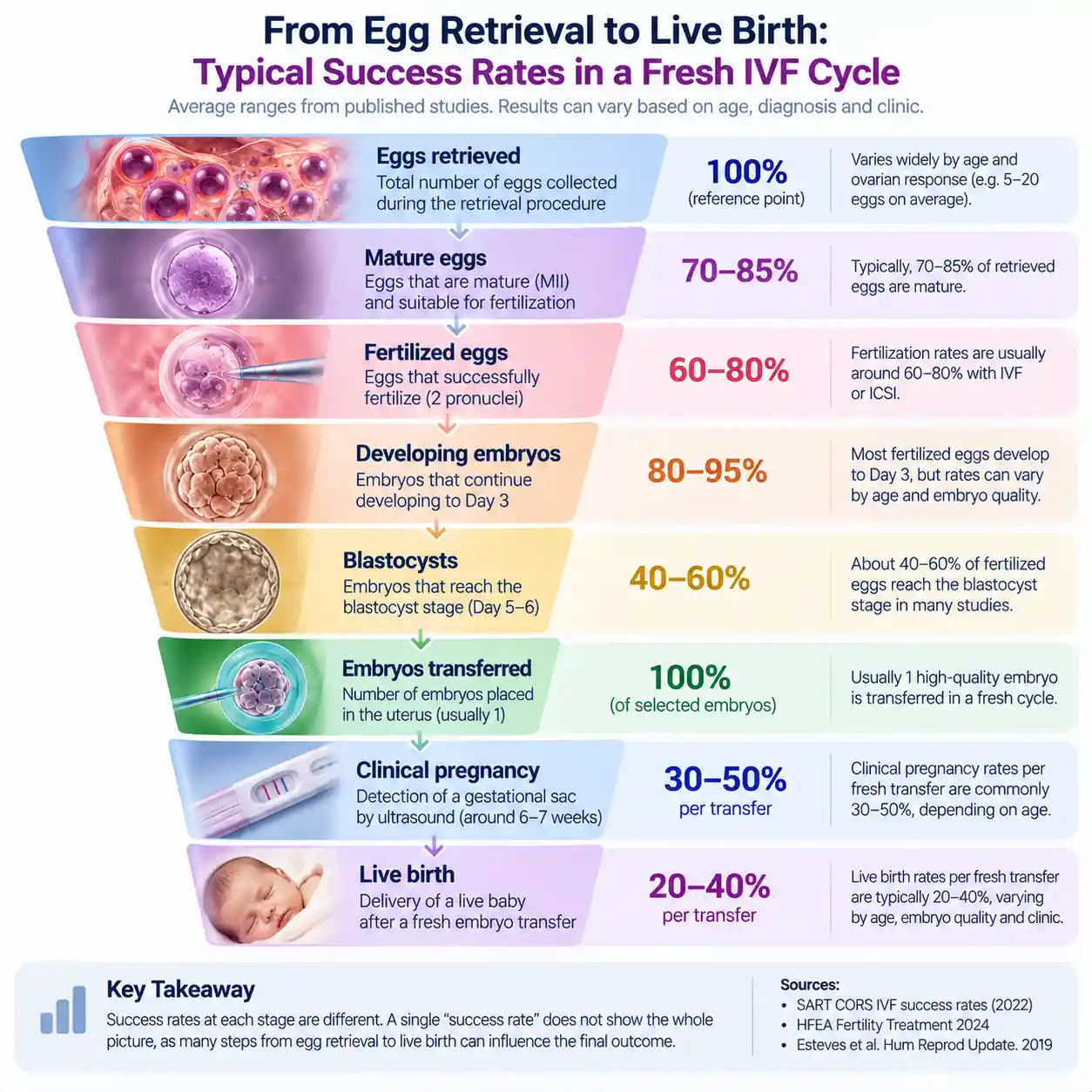
Fresh Embryo Transfer Success: What Do the Numbers Mean?
There is no single fresh embryo transfer success rate that applies to every patient.
A clinic might report:
- Pregnancy per embryo transfer
- Clinical pregnancy per transfer
- Implantation rate
- Live birth per transfer
- Cumulative live birth after several transfers
These are different measurements.
For example, a pregnancy rate can be higher than a live-birth rate because not every clinical pregnancy results in a live birth.
Factors That Affect Fresh Embryo Transfer Success
| Factor | Why it matters |
|---|---|
| Age | Egg quality and chromosome status change with age |
| Embryo quality | Development and morphology affect transfer potential |
| Egg source | Patient's own eggs and donor eggs have different age-related factors |
| Sperm factors | Sperm quality can affect fertilization and embryo development |
| Endometrial condition | The uterus needs to be prepared for implantation |
| Hormone levels | Stimulation changes the hormonal environment |
| Embryo stage | Day 3 and Day 5/6 transfers are different |
| Genetic status | Chromosomal abnormalities can affect implantation and miscarriage |
| Medical conditions | Conditions such as adenomyosis may affect IVF outcomes |
| Laboratory quality | Embryo culture and laboratory procedures matter |
Fresh embryo transfer success depends on the whole IVF cycle, not just whether the embryo was fresh or frozen.
Is Fresh Embryo Transfer Better Than Frozen?
This is one of the most common questions patients ask.
The answer is: not necessarily.
Fresh and frozen embryo transfer are different ways of timing the same basic goal — placing a suitable embryo into a prepared uterus.
For some patients, fresh transfer can be appropriate. For others, freezing the embryos first provides important medical or practical advantages.
The choice should therefore be based on the patient's circumstances rather than assuming that one method is always better.
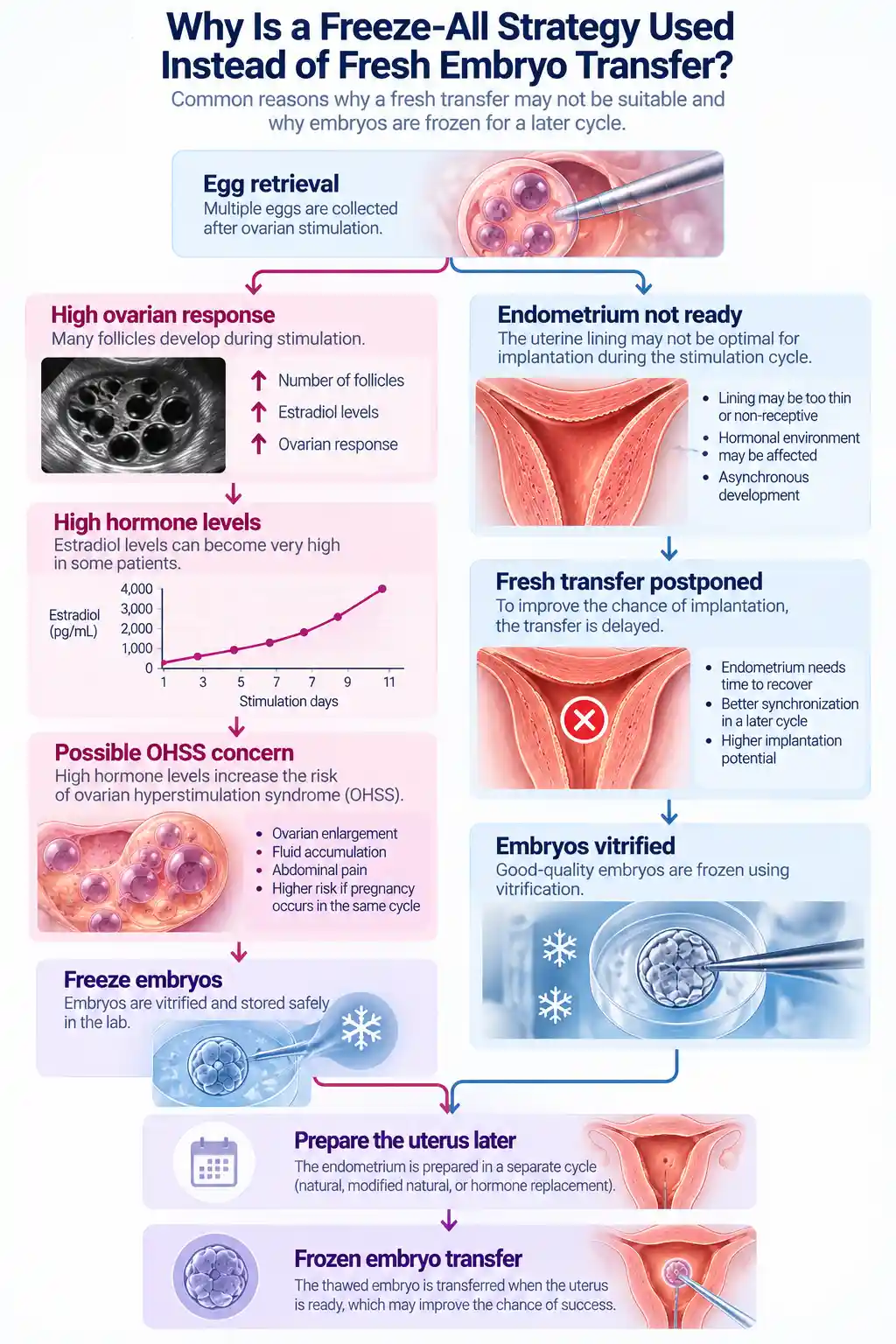
Fresh vs Frozen: Where Each Approach May Fit
| Situation | Fresh transfer | Frozen transfer |
|---|---|---|
| No need for genetic testing | Possible | Possible |
| High OHSS risk | May be avoided | Often considered |
| PGT planned | Usually not suitable | Usually needed |
| Need to delay transfer | No | Yes |
| Hormonal environment needs time | Less flexible | More flexible |
| Suitable uterine lining in stimulation cycle | May be considered | Also possible |
| Need to transfer quickly | Advantage | Less immediate |
| More control over transfer timing | Limited | Greater |
Why Might a Clinic Choose Freeze-All?
A freeze-all approach means that embryos created during an IVF cycle are frozen instead of transferring an embryo immediately.
This does not mean the embryos are being discarded or that the IVF cycle has failed.
It simply means that embryo transfer is moved to a later cycle.
Common reasons for freeze-all include:
- High risk of OHSS
- Hormone levels that make fresh transfer less suitable
- Need for PGT
- Uterine lining concerns
- Medical reasons to delay pregnancy
- Need for additional time to plan the transfer
- Other individual factors identified during the IVF cycle
A frozen cycle can also provide more flexibility because the uterus can be prepared separately from ovarian stimulation.
Freeze-all changes the timing of transfer; it does not mean the IVF cycle was unsuccessful.
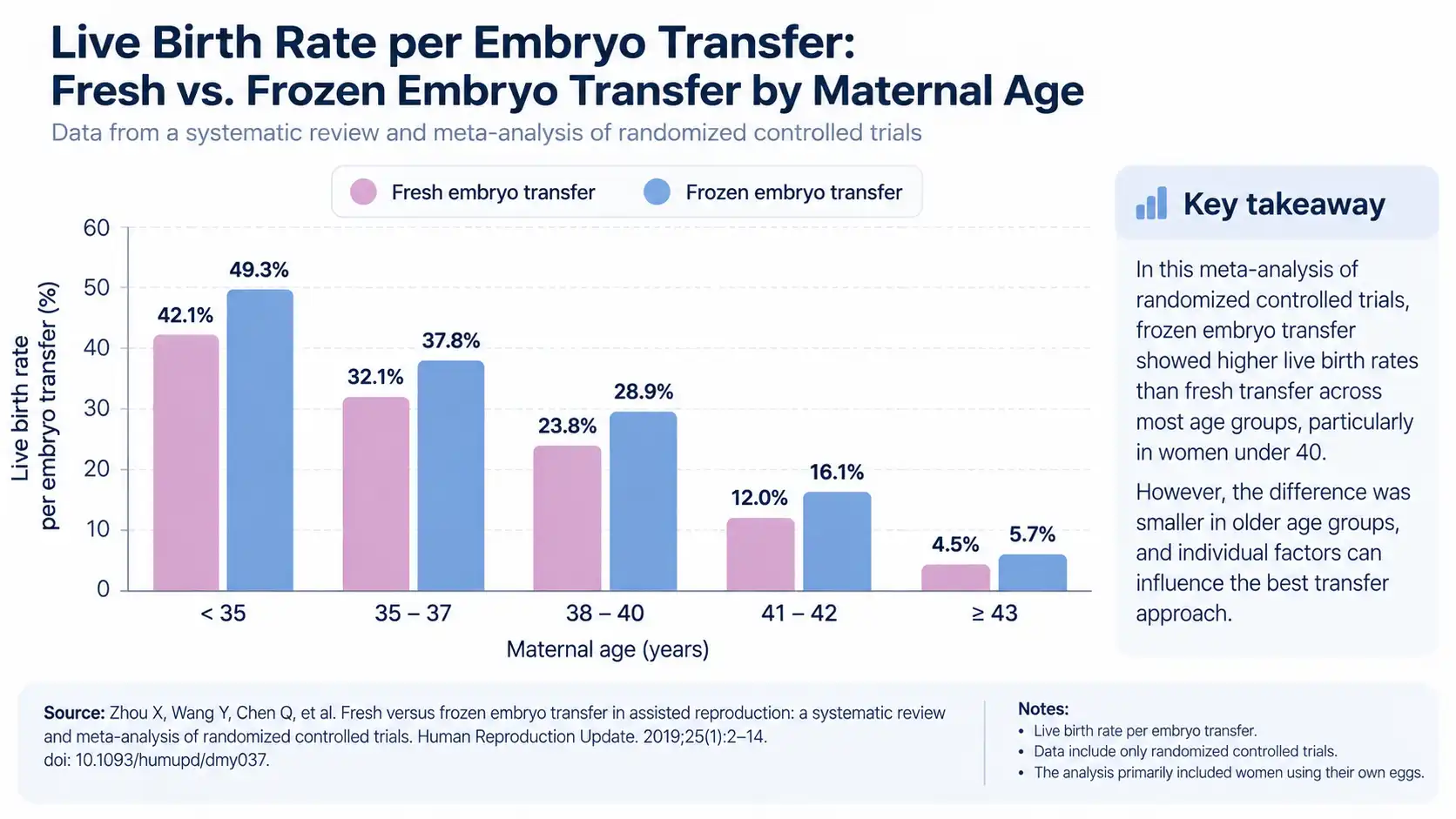
Does Frozen Transfer Always Have a Higher Success Rate?
No.
Some studies have found advantages for frozen transfer in particular groups, but that does not mean every patient will have a better outcome with a frozen embryo.
The comparison is complicated because patients who receive frozen embryos are not always the same as patients who receive fresh embryos.
For example, a patient undergoing PGT will usually enter a frozen-transfer pathway. A patient with a high risk of OHSS may also be more likely to have embryos frozen.
This means that simply comparing the IVF success rate of fresh and frozen transfers without considering who was treated and why can give a misleading impression.
What Does Recent Research Say About Fresh vs Frozen Transfer?
Research published in recent years has made the picture more specific rather than simply showing that one method is always superior.
A 2026 systematic review focused specifically on women who responded poorly to ovarian stimulation and compared fresh and frozen embryo transfer. This is important because low responders are a different patient group from patients who produce many eggs, so results from one group should not automatically be applied to everyone.
This is one reason treatment decisions should be based on the patient's ovarian response and overall clinical picture rather than on a single overall IVF statistic.
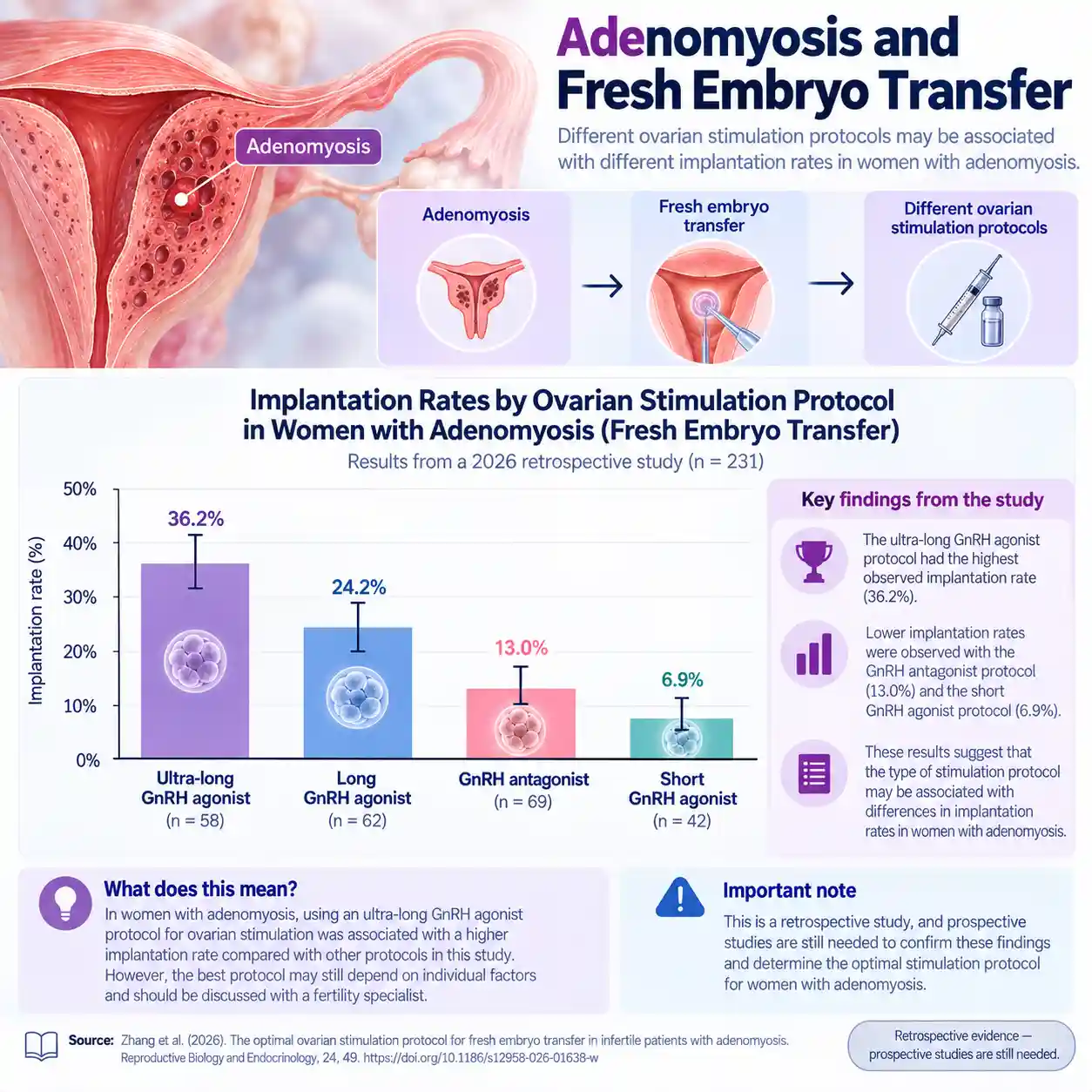
Fresh Embryo Transfer in Women With Adenomyosis
Adenomyosis is another situation where the details of the IVF protocol may matter.
A 2026 systematic review and network meta-analysis examined different ovarian stimulation protocols in women with adenomyosis undergoing fresh embryo transfer. The review included seven retrospective studies.
The researchers found that an ultra-long GnRH agonist protocol had the highest implantation rate among the protocols studied and was statistically better than antagonist and short protocols for implantation. However, the analysis did not find significant differences between the protocols for clinical pregnancy, miscarriage, or live birth. The authors also noted that the evidence was based on retrospective studies and that prospective research is still needed.
This distinction matters.
A protocol may look better for implantation without proving that it produces more live births.
The same analysis found that clinical pregnancy and live-birth outcomes were similar between focal and diffuse adenomyosis, while focal adenomyosis was linked with a lower miscarriage risk in the included data.
At VitaLife, conditions such as adenomyosis are therefore not something we would treat as a minor detail. They can be part of the discussion when deciding how ovarian stimulation and embryo transfer should be planned.
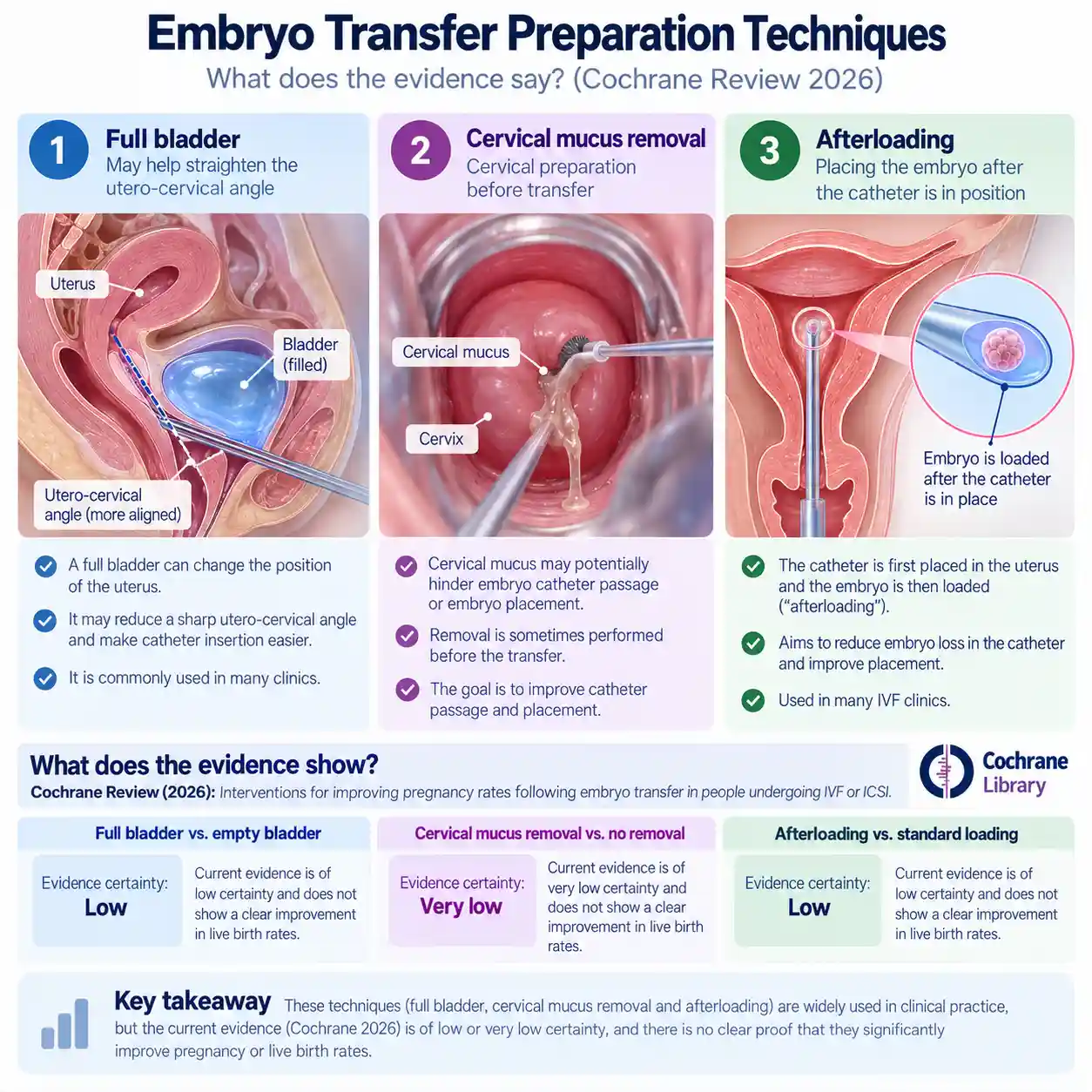
Does Endometrial Preparation Really Change Fresh Transfer Success?
The uterus is obviously important during embryo transfer, but not every technique used around transfer has been shown to improve live birth.
A 2026 Cochrane review examined several techniques used before embryo transfer, including:
- Using a full bladder to straighten the uterine angle
- Removing cervical mucus
- Different ways of passing the catheter through the cervix
The review included 11 studies involving 2,524 women, but the authors judged much of the evidence to be low or very low certainty.
For example, the evidence did not show a clear improvement in pregnancy rate from using a full bladder compared with an empty bladder. Removing cervical mucus also showed little or no clear difference in pregnancy rate in the available studies.
The review also found that embryo afterloading may have little or no effect on pregnancy rate compared with direct embryo transfer, although some evidence suggested it could make the transfer technically easier.
What does this mean for patients?
It means that not every small adjustment around embryo transfer has been proven to increase the chance of having a baby.
A careful transfer matters, but we should not assume that every transfer technique improves success just because it sounds helpful.
What Happens After Fresh Embryo Transfer?
After the embryo has been transferred, there is a waiting period before pregnancy can be confirmed.
You may experience:
- Mild cramping
- Light spotting
- Bloating
- Breast tenderness
- Vaginal discharge
These symptoms do not reliably tell you whether implantation has happened.
Some patients have no symptoms at all and still become pregnant.
What to Do After Fresh Embryo Transfer
Your clinic will give you specific instructions, but in general:
- Continue prescribed medications exactly as directed.
- Avoid stopping progesterone or other medication because of mild symptoms.
- Follow your clinic's advice about exercise and sexual activity.
- Contact your clinic if you develop significant pain or heavy bleeding.
- Attend the scheduled pregnancy test rather than relying on symptoms.
Feeling pregnant — or not feeling anything — does not confirm the result.
Implantation After Fresh Embryo Transfer
Implantation is the process in which the developing embryo attaches to the uterine lining.
The timing depends on the embryo's developmental stage.
For a blastocyst transfer, implantation-related changes can begin relatively soon after transfer, but the process is not something you can reliably feel.
The hormone hCG becomes detectable after implantation and is the basis of the pregnancy test.
This is why testing too early can be confusing.
The pregnancy test is more useful than trying to read symptoms during the waiting period.
What If the Fresh Embryo Transfer Fails?
A failed fresh embryo transfer does not necessarily mean that IVF cannot work.
There are many possible reasons an embryo transfer does not lead to pregnancy, including:
- Embryo chromosome abnormalities
- Embryo development
- Implantation problems
- Uterine or endometrial factors
- Age-related factors
- Sperm or egg factors
- Chance
If additional embryos were frozen from the same egg retrieval, another transfer may be possible without repeating ovarian stimulation and egg retrieval.
The next step depends on why the first transfer failed and what embryos remain available.
One unsuccessful transfer does not tell the whole story of a patient's IVF chances.
Fresh Embryo Transfer vs Frozen Embryo Transfer: Which Is Better?
There is no universal winner between fresh and frozen embryo transfer.
A more useful question is:
Which approach makes the most sense for this particular IVF cycle?
Fresh transfer may make sense when:
- The patient has a suitable uterine environment.
- Hormone levels are considered appropriate.
- OHSS risk is not a major concern.
- Genetic testing is not delaying the transfer.
- A suitable embryo is available at the appropriate stage.
- There is no medical reason to postpone pregnancy.
Frozen transfer may make more sense when:
- PGT is planned.
- OHSS risk is significant.
- Hormone levels or the stimulation response make immediate transfer less suitable.
- The endometrium needs additional preparation.
- There is a medical reason to delay pregnancy.
- The treatment team wants greater control over the timing of transfer.
| Question | Fresh | Frozen |
|---|---|---|
| Transfer in the retrieval cycle? | Yes | No |
| Embryo frozen first? | No | Yes |
| PGT before transfer? | Generally no | Yes |
| More timing flexibility? | Less | More |
| Can avoid immediate transfer with OHSS risk? | No | Yes |
| Requires preparation of a later cycle? | No | Yes |
How We Decide Between Fresh and Frozen Transfer
At VitaLife, we do not choose fresh or frozen transfer simply because one method is more popular.
We consider:
- Age and reproductive history
- Ovarian reserve and response to stimulation
- Hormone levels
- Number of eggs retrieved
- Fertilization results
- Embryo development
- Endometrial condition
- Risk of OHSS
- Whether PGT is planned
- Conditions such as adenomyosis
- The number of embryos available
- The patient's overall treatment plan
The plan can also change during the IVF cycle.
For example, a patient may initially be expected to have a fresh transfer, but if the ovarian response becomes stronger than expected or the risk of OHSS increases, the team may recommend freezing the embryos instead.
In IVF, the transfer plan can change when the medical information changes.
Fresh Embryo Transfer: The Key Points
A fresh embryo transfer means transferring an embryo during the same IVF cycle in which the eggs were retrieved.
The main points to remember are:
- Fresh transfer usually happens a few days after egg retrieval.
- It can involve a Day 3 or Day 5/6 embryo, depending on the treatment plan.
- Hormone levels and endometrial readiness matter.
- OHSS risk can be an important reason to avoid fresh transfer.
- PGT generally requires embryos to be frozen while testing is completed.
- Fresh transfer is not automatically better than frozen transfer.
- Frozen transfer provides more flexibility over the timing of embryo transfer.
- Success rates should be compared using the same outcome measure and patient group.
- Embryo quality, age, egg source and the overall IVF cycle can have a major effect on the result.
- Recent research continues to show that the best approach may differ between patient groups.
The important question is not simply "fresh or frozen?" It is whether the embryo, the uterine environment and the patient's medical situation are aligned at the time of transfer.
At VitaLife, our approach is to review these factors together and choose the transfer strategy that fits the individual IVF cycle.
What is a fresh embryo transfer?
A fresh embryo transfer is when an embryo created during an IVF cycle is transferred into the uterus without being frozen first. It usually takes place a few days after egg retrieval.
When is fresh embryo transfer done?
Fresh embryo transfer is usually done about 3 to 5 days after fertilization, depending on embryo development and the treatment plan. Some embryos may be transferred at the Day 3 stage, while others are transferred as blastocysts around Day 5 or Day 6.
Is fresh embryo transfer better than frozen?
Not necessarily. Both approaches can be appropriate. The choice depends on hormone levels, endometrial readiness, embryo development, OHSS risk, genetic testing and other individual factors.
What are the benefits of fresh embryo transfer?
The main benefit is timing. The embryo can be transferred during the same IVF cycle without waiting for a later frozen embryo transfer cycle.
What is a 3 day fresh embryo transfer?
A 3 day fresh embryo transfer places a cleavage-stage embryo into the uterus about three days after fertilization. It is different from a Day 5 blastocyst transfer.
What is a 5 day fresh embryo transfer?
A 5 day fresh embryo transfer involves transferring a blastocyst after about five days of embryo development. By this stage, the embryo has developed into a more complex structure.
Can you do PGS testing on fresh embryos?
PGS, now generally called PGT-A, cannot normally provide a result in time for a standard fresh transfer. The embryo is usually biopsied at the blastocyst stage, vitrified, and transferred later after the genetic testing result is available.
What happens after fresh embryo transfer?
After fresh embryo transfer, the embryo may implant in the uterine lining. The patient usually continues prescribed medication and waits for a blood pregnancy test, commonly performed about 9 to 14 days after transfer.
What should you do after fresh embryo transfer?
Continue your prescribed medication and follow the instructions from your fertility team. Mild cramping or spotting can occur, but significant pain or heavy bleeding should be reported to the clinic.
What happens if a fresh embryo transfer fails?
If the transfer does not result in pregnancy, the treatment team can review the embryo, uterine, hormonal and other factors involved. If additional frozen embryos are available, another transfer may be possible without repeating egg retrieval.
Can a Day 6 embryo be transferred fresh?
A Day 6 embryo can reach the blastocyst stage later than a Day 5 embryo. Whether it can be transferred fresh depends on its development, quality and the timing of the cycle.
Does fresh embryo transfer have a higher success rate?
There is no single success rate for fresh embryo transfer. Outcomes depend on factors such as age, embryo quality, egg source, sperm factors, uterine conditions and how success is measured.
References
- Yamaji N, Akino R, Sasayama K, et al. Techniques for preparation prior to embryo transfer. Cochrane Database of Systematic Reviews. Version published August 6, 2026. Cochrane Library review
- Syams HH, Bayuaji H, Tjahyadi D, et al. Comparative efficacy of different IVF stimulation protocols in women with adenomyosis undergoing fresh embryo transfer: a systematic review and network meta-analysis. Archives of Gynecology and Obstetrics, 2026. Springer article
- Sun Y, Sun X, Gemzell-Danielsson K. Frozen versus fresh embryo transfer in low responders: a systematic review. Fertility and Sterility, 2026. ScienceDirect article
Comments 0
Share a question or experience related to this article. Comments appear after review by our team.
No comments yet. You can start the conversation.