Egg Retrieval for Surrogacy
Egg retrieval for surrogacy involves collecting eggs from the intended mother or an egg donor, fertilizing them through IVF, and preparing the resulting embryos for transfer to a gestational carrier.
 By Dr. Farah GhasemiGynecologist & Obstetrician · Subspecialist in Infertility & IVF
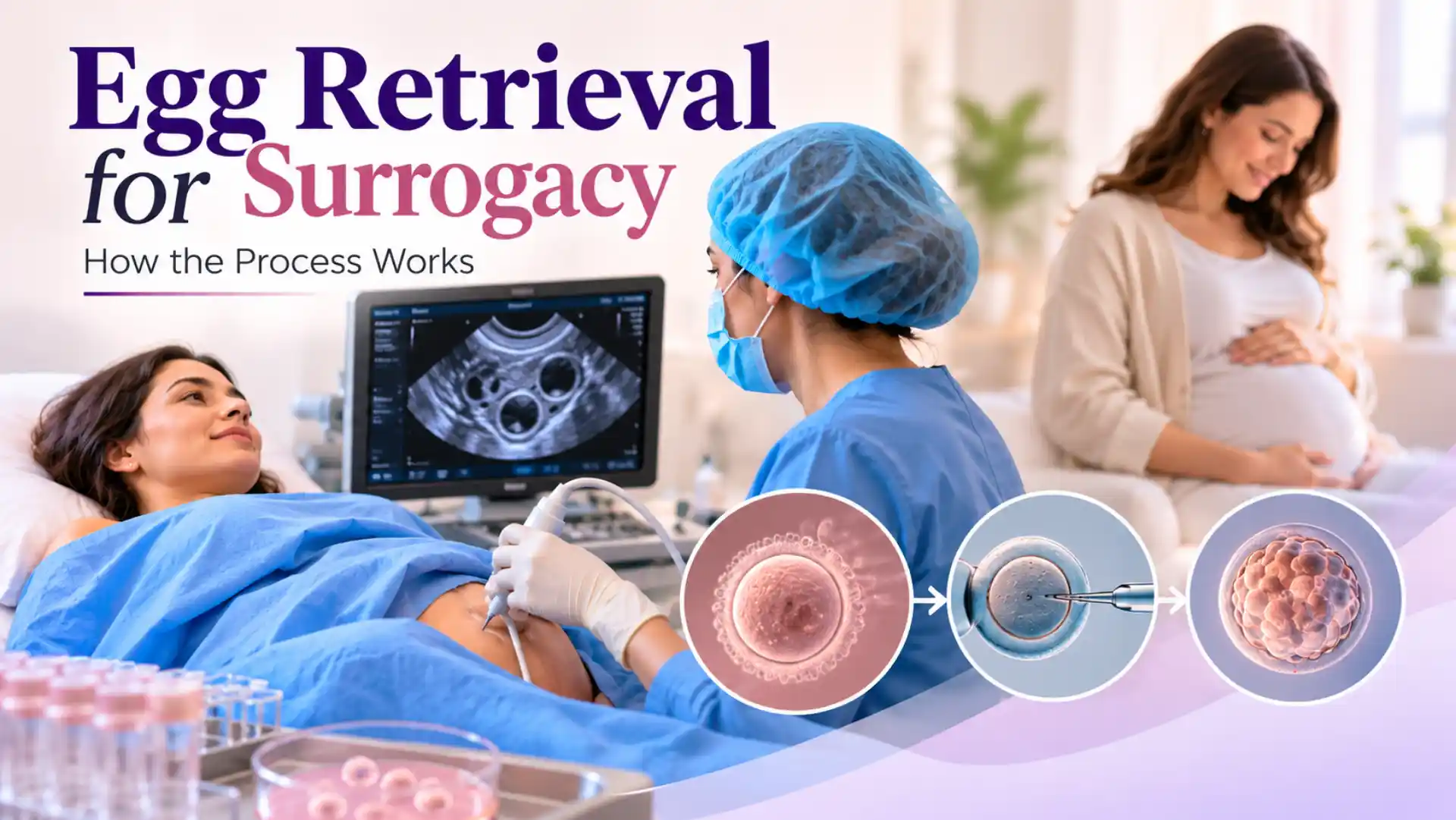
Table of contents16 sections
Egg retrieval for surrogacy is an important step in creating embryos for a gestational carrier. The process involves stimulating the ovaries, collecting mature eggs, fertilizing them in a laboratory, and preparing suitable embryos for transfer. However, not everyone who needs a surrogate must use donor eggs. Depending on their medical condition, intended parents may be able to use eggs from the intended mother, an egg donor, or previously frozen eggs.
Understanding how egg retrieval works can help intended parents prepare for treatment and make informed decisions with their fertility team.
What Is Egg Retrieval in Surrogacy?
In gestational surrogacy, the surrogate carries the pregnancy but does not provide the egg. Instead, an embryo is created through IVF using eggs from the intended mother or an egg donor and sperm from the intended father or a sperm donor.
This is different from traditional surrogacy, in which the surrogate also provides the egg. This article focuses on gestational surrogacy.
Egg retrieval is the procedure used to collect eggs from the ovaries before fertilization. The resulting embryos can then be transferred to the gestational carrier's uterus.
Can You Use Your Own Eggs If You Need a Surrogate?
Needing a gestational surrogate does not automatically mean you need donor eggs. Some women cannot safely carry a pregnancy but may still be able to undergo ovarian stimulation and egg retrieval.
For example, a medical condition affecting the uterus or making pregnancy dangerous may prevent a woman from carrying a baby without affecting her ability to produce eggs. In such cases, her own eggs may be collected and used to create embryos for transfer to a gestational carrier.
However, some conditions can affect both the ability to carry a pregnancy and ovarian function. If ovarian stimulation or egg retrieval is medically unsuitable, or if the ovarian response is expected to be very low, donor eggs may be considered.
The appropriate option depends on ovarian reserve, medical history, previous fertility treatment, and an individualized assessment by a fertility specialist.
Step 1: Ovarian Stimulation
The first stage of the egg retrieval process is ovarian stimulation. During a natural menstrual cycle, usually one egg matures and is released. IVF medications encourage the ovaries to develop multiple follicles so that several eggs may be collected in one cycle.
The treatment commonly involves daily hormone injections for approximately 8–14 days, although the duration varies between patients.
During this period, the fertility team monitors the ovaries through ultrasound scans and, when needed, blood tests. These assessments help determine how the follicles are developing and whether medication doses should be adjusted.
The stimulation protocol is individualized. Factors such as age, ovarian reserve, previous treatment response, and the risk of ovarian hyperstimulation syndrome (OHSS) can influence the treatment plan.
Step 2: Trigger Injection and Egg Retrieval
When the follicles have developed sufficiently, the patient receives a trigger injection to support the final maturation of the eggs. Egg retrieval is usually scheduled approximately 34–36 hours after the trigger, according to the clinic's protocol.
The procedure is generally performed under sedation. Using ultrasound guidance, the physician passes a thin needle through the vaginal wall to reach the ovarian follicles and collect their fluid, which may contain eggs.
Egg retrieval typically takes around 15–30 minutes, although the time can vary. Patients are usually monitored for a short period afterward and can often return home the same day.
Mild cramping, bloating, and light spotting may occur after the procedure. However, severe or worsening abdominal pain, heavy bleeding, fever, persistent vomiting, or difficulty breathing should be reported to the clinic promptly.
Step 3: Egg Assessment and Fertilization
After retrieval, the embryology laboratory examines the collected eggs and determines which are mature enough for fertilization.
The number of eggs retrieved is not necessarily the same as the number of mature eggs. Some follicles may not contain an egg, and some collected eggs may not have reached the appropriate stage of maturity.
Mature eggs are then fertilized using one of two main methods:
- Conventional IVF: Eggs and prepared sperm are placed together in a laboratory dish to allow fertilization.
- ICSI: An embryologist injects a single sperm directly into an egg. This method may be recommended in cases such as significant male-factor infertility or previous fertilization problems.
The decision to use IVF or ICSI depends on the clinical circumstances. ICSI is not automatically necessary for every surrogacy cycle.
Step 4: Embryo Development and Genetic Testing
After fertilization, embryos are monitored in the laboratory as they develop. Some may stop developing before reaching the blastocyst stage, which usually occurs around day 5 or 6.
The embryologist evaluates embryo development and morphology to help identify suitable embryos for transfer or freezing.
Genetic testing may also be considered, depending on the parents' medical history and treatment goals. For example:
- PGT-A assesses embryos for changes in chromosome number.
- PGT-M tests for a specific inherited genetic condition.
- PGT-SR may be used when a genetic parent has a structural chromosome rearrangement.
These tests are not required in every IVF or surrogacy process. Their suitability should be discussed with a fertility specialist and genetic counselor. Genetic testing can provide additional information, but it does not guarantee implantation, pregnancy, or the birth of a healthy baby.
It is also important to distinguish embryo testing from carrier screening. Before treatment, the genetic contributors to the embryo may be offered carrier screening for inherited conditions such as cystic fibrosis, spinal muscular atrophy, and thalassemia or other hemoglobin disorders. When appropriate, screening the egg and sperm sources for the same conditions helps assess the risk of certain inherited diseases.
Step 5: Preparing the Gestational Carrier for Embryo Transfer
Once suitable embryos are available, the next stage is preparing the gestational carrier's uterus for embryo transfer.
The carrier undergoes medical screening and evaluation before treatment. Her endometrial lining is then prepared according to the selected transfer protocol. This may involve monitoring a natural or modified natural cycle, or using medications such as estrogen and progesterone in a programmed cycle.
The timing depends partly on whether the clinic plans a fresh or frozen embryo transfer.
Fresh vs. Frozen Embryo Transfer in Surrogacy
With a fresh embryo transfer, the egg retrieval and the gestational carrier's preparation must be coordinated within the same treatment cycle. The carrier's uterine lining needs to be ready at the appropriate time for the embryo's developmental stage.
With a frozen embryo transfer (FET), embryos are frozen after development and transferred during a later cycle. This gives the clinic more flexibility to prepare the carrier separately from the egg retrieval cycle.
Frozen transfer can be particularly useful when additional time is needed for medical evaluation, genetic testing, or recovery from ovarian stimulation. However, frozen transfer is not automatically more successful than fresh transfer. The most appropriate approach depends on the medical circumstances and the clinic's assessment.
How Many Frozen Embryos Do We Transfer in Surrogacy?
At VitaLife, our frozen embryo transfer approach typically involves transferring two embryos to the gestational carrier. In selected cases, we may consider transferring up to three embryos, depending on embryo quality, the age of the egg provider, previous transfer outcomes, and the gestational carrier's medical condition.
Our aim is to improve the chance of achieving pregnancy in each transfer attempt. However, transferring multiple embryos does not guarantee pregnancy or a live birth. It also increases the possibility of a multiple pregnancy, including twins or triplets.
What Affects the Outcome of Egg Retrieval for Surrogacy?
The number of eggs collected and the likelihood of obtaining embryos suitable for transfer vary between individuals. Important factors include:
- Age of the person providing the eggs
- Ovarian reserve and response to stimulation
- Egg maturity and quality
- Sperm quality and fertilization results
- Embryo development and chromosomal status
- Laboratory conditions and clinical experience
Not every retrieved egg will be mature, not every mature egg will fertilize, and not every fertilized egg will develop into a suitable embryo. Therefore, the initial egg count alone cannot predict the final treatment outcome.
Frequently Asked Questions
Does the surrogate undergo egg retrieval?
No. In gestational surrogacy, egg retrieval is performed on the intended mother or an egg donor. The gestational carrier undergoes preparation for embryo transfer and carries the pregnancy.
How long does egg retrieval take for surrogacy?
Ovarian stimulation commonly takes about 8–14 days. The retrieval procedure itself usually takes around 15–30 minutes, and the overall timeline depends on monitoring, fertilization, embryo development, and the planned transfer method.
Can frozen eggs be used in surrogacy?
Yes. Previously frozen eggs can be thawed, fertilized in the laboratory, and developed into embryos. Their suitability depends on factors such as the age at which they were frozen, egg survival after warming, and subsequent fertilization and embryo development.
Can egg retrieval be performed if vaginal access is difficult?
In selected cases, when the ovaries cannot be safely reached through the usual vaginal ultrasound-guided approach, the fertility team may consider an alternative retrieval method. This is uncommon and depends on the individual's anatomy and medical circumstances.
Planning Egg Retrieval for Your Surrogacy Journey
Egg retrieval is only one part of the gestational surrogacy process, but it plays an important role in determining which embryos may be available for transfer. The treatment plan should take into account the egg provider's health, the sperm source, embryo development, and the gestational carrier's medical readiness.
At VitaLife, intended parents can receive guidance on the available fertility treatment and surrogacy in Iran. A medical evaluation is the first step toward determining whether using your own eggs, donor eggs, or previously frozen eggs is the most appropriate approach for your circumstances.
Comments 0
Share a question or experience related to this article. Comments appear after review by our team.
No comments yet. You can start the conversation.